
Chapter 14
Prayer as a Lifestyle
"Pray without ceasing." — 1 Thessalonians 5:17
Introduction
Most of us already know what constant connection feels like. There is someone in your life—a spouse, a parent, a closest friend—whose name surfaces first when something happens. Good news, bad news, a beautiful sunset, a terrible day—before you have even formed the words, they are the first person you think of. You do not schedule this. You do not force it. It is the natural fruit of a relationship so practiced and so trusted that turning toward that person has become instinct.
This chapter asks whether God holds that place in your life—and what changes when He does become "the first person" we think of.
The apostolic letter to the saints in Thessalonica counselled them about daily life as a disciple of Jesus Christ. "Rejoice evermore" and "Pray without ceasing" (1 Thessalonians 5:16–17). We believe that the latter command enables the former.
Continual prayer is not talking constantly. Rather, it is the indicator of a soul so connected to the Lord that every moment—the ordinary, the urgent, the joyful, the grieving—is lived within His companionship. Latter-day Saints direct their prayers to God the Father in the name of Jesus Christ, following the pattern the Savior Himself established. But the practice of constant prayer is not about addressing protocol. It is about who occupies the center of your attention—who your heart reaches for first.
Chapter 5 of Words of Plainness explored the foundations of sincere prayer—what prayer is, how we approach God, the pattern Christ taught, and the forms prayer can take. This chapter assumes you know how to pray. It asks, "Has prayer become your way of life?" Each card explores a dimension of that lifestyle: constant awareness, focused fasting, outward intercession, and receptive listening.
The cards in this chapter draw from the teachings on prayer explored in Chapter 5: Sincere Prayer, and from Christ's instruction on prayer in the Sermon on the Mount (Matthew 6:5–13). If you feel familiar enough with these teachings to be ready to make discipleship commitments, proceed to the cards below. If you would like to revisit the foundations first, Chapter 5: Sincere Prayer will walk you through them at your own pace. The discipleship practice cards will be here when you're ready.
How This Chapter Works
Each card below explores a practice of discipleship. Read how Latter-day Saints understand and live it, consider how it blesses, then decide how you will practice it in your own life.



Pray Without Ceasing — A Life of Constant Prayer
Making God the First Person You Turn To
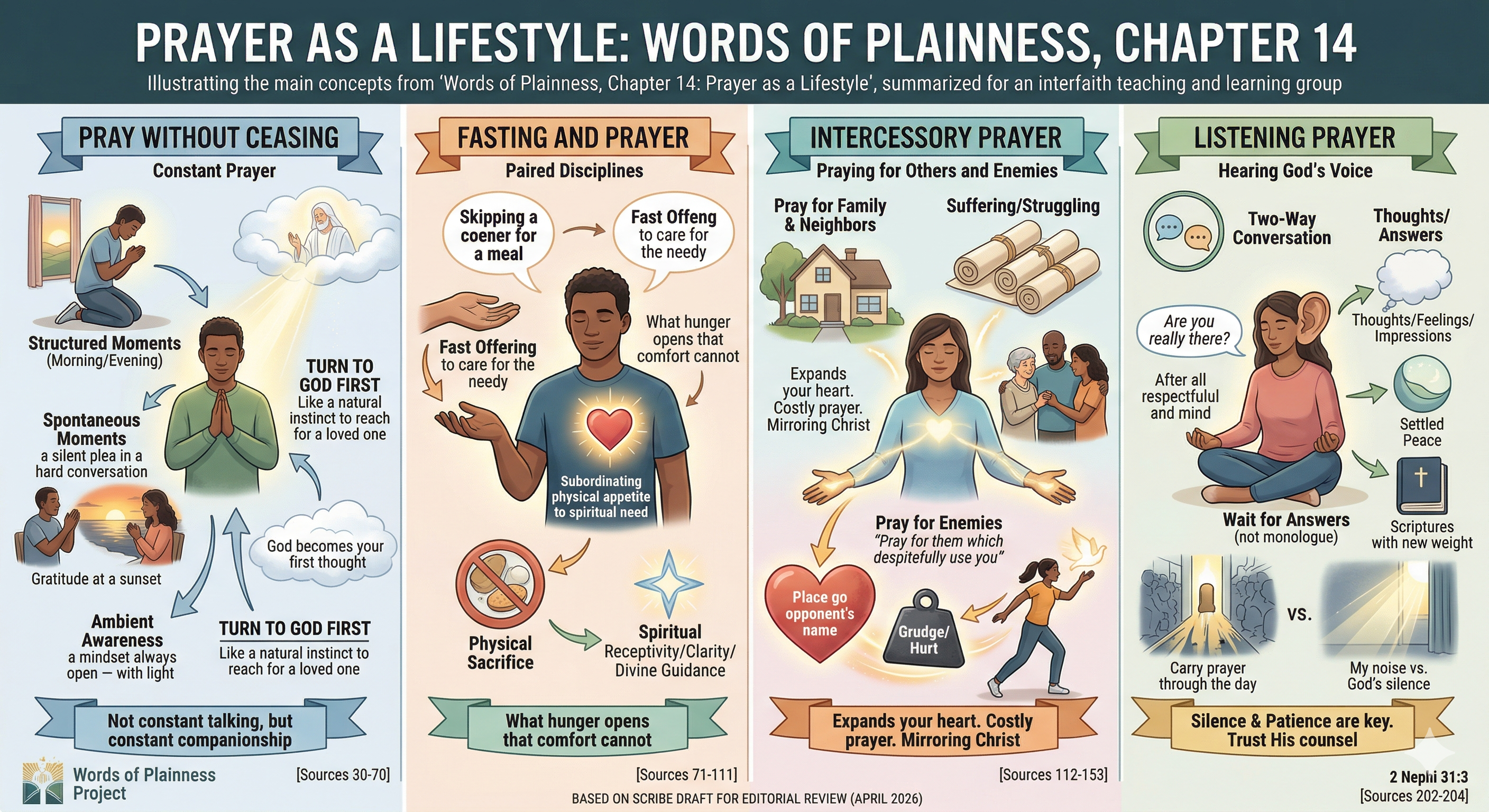
We practice prayer more as an environment than an event—an ongoing awareness that we are never alone, never unheard, never walking through the day without God. We are not commanded to recite words every waking moment. Continual prayer is the description of a life so connected to the Lord that turning toward Him has become instinct—the way you instinctively reach for the person who matters most to you when something happens.
This plays out in three ways, and all three are one practice. We pray in structured moments—morning and evening, on our knees when possible, with deliberate attention. We pray in spontaneous moments—a silent plea in a hard conversation, a flash of gratitude at the sight of something beautiful, a cry for help when the news is bad. And we maintain an ambient awareness throughout the day—a prayerful mindset that keeps the channel open even when we are not consciously praying. Nephi taught, "Ye must pray always, and not faint; ye must not perform any thing unto the Lord save in the first place ye shall pray unto the Father in the name of Christ" (2 Nephi 32:9).
The way you became close to your dearest friend was not by scheduling three conversations per day. It was by frequently checking in, and including them in everything—the ordinary, the urgent, the joyful, the grieving. They matter to you because you give them access to your real life. Constant prayer is the same discipline applied to God. The structured prayers are the foundation. The constant prayer is the fruit—the growing awareness that every moment of your life is lived in the presence of Someone who knows you fully and loves you unconditionally.
When God Became the First Voice
For years my prayers were like bookends—one in the morning, one at night, with a long silence in between as my mind focused on the many tasks of the day. I was usually faithful about showing up to prayer on a schedule, but I was not in a relationship. I was completing an assignment. The hours between my prayers belonged to me, and I navigated them on my own strength and leaning to my own understanding.
The shift did not come through discipline. It came through desperation. As I began to shoulder the overwhelming responsibilities and mundane routines of adult life, a season arrived when the problems were too constant for morning-and-evening to hold, especially after beginning my adventures as a husband and father. I began turning to God in the car, in the hallway, during conversations that were going sideways. Not always eloquent prayers. Fragments. "Help me see this clearly." "God, give me patience fast." "Lord, I don't know what I'm doing." And something changed—not the circumstances, but my awareness. I began to sense that He had always been there in the middle of my day. I had just never turned toward Him until the pain and anxiety forced it. The comfort and peace of His Spirit became a part of my natural habitat, an environmental resource.
These days the "turning" of my soul is less desperate and more natural. Not every moment, but far more moments than before. I reach for Him the way I reach for my wife when something matters. Not because I should turn to God, but because He is the one I trust most.
Constant prayer is not perfection—it is direction. The commitment on the next tab invites you to begin noticing who you turn to first, and to practice turning toward God.
Writing Prompt
When something unexpected happens—good or bad—who is the first person your heart reaches for? What would change if that person were God?
Fasting and Prayer — The Paired Disciplines
What Hunger Opens That Comfort Cannot
We pair fasting with prayer because the body and the spirit are connected, and what we do with one affects the other. Fasting is the deliberate choice to go without food and drink for a sacred purpose—to subordinate physical appetite to spiritual need. It is not punishment. It is not a spiritual stunt. It is a declaration of independence from the mortal conditions of the flesh and dependence on the Lord's grace: "Man shall not live by bread alone, but by every word that proceedeth out of the mouth of God" (Matthew 4:4).
On the first Sunday of each month, many Latter-day Saints fast for two consecutive meals and donate the money saved—or more if resources allow—as a "fast offering" to care for the poor and needy of our communities. This links fasting directly to generosity: we go without so that others can have. The prophet Isaiah taught that the fast God honors is the one that loosens the bonds of wickedness, feeds the hungry, and covers the naked—and when we fast this way, "then shalt thou call, and the Lord shall answer; thou shalt cry, and he shall say, Here I am" (Isaiah 58:9).
Beyond the monthly fast, we fast whenever we face decisions that require divine guidance, when we seek healing for ourselves or others, or when we need an extra measure of God's spiritual strength. Alma testified that he had "fasted and prayed… that I might know these things of myself" (Alma 5:46). The sons of Mosiah "had given themselves to much prayer, and fasting; therefore they had the spirit of prophecy, and the spirit of revelation" (Alma 17:3). Fasting for a wise length of time sharpens spiritual receptivity in a way that prayer alone sometimes does not. It strips away the noise and leaves us open to hear God in ways our comfortable lives often do not permit.
What Hunger Taught Me
As a young man, the first few fasts I kept were miserable. I watched the clock, thought about food, and accomplished nothing spiritual. I was fasting from meals. I had not yet learned to fast toward God. And I often broke the fast with a sigh of relief and feasted to celebrate the end of my suffering. I was missing the point as well as missing out on the blessings.
One fast that helped change my attitude about this was right after our congregation bought my young family groceries and baby supplies when I was struggling to provide. When it became a reality to me that others had sacrificed and offered their own resources to help us when we had none, my own fasts became acts of gratitude in the hope of helping other struggling families.
Another experience that focused my thinking about the partnership between fasting and prayer was the first time a patient died in my care as an Emergency Medical Technician. I grieved, my thoughts ruminating over whether I had made any mistakes in the care I provided. My ambulance partner and bosses reassured me that I had done everything right, but I couldn't let go of it. I couldn't eat. It was an accidental fast at first, one of desperation. I could not change what happened. Then the mindful combination of fasting and prayer changed me as the grace of God responded to my prayers for healing.
When we have no control over situations and challenges, we can still surrender to God our appetites and passions for a season—and say, "I have nothing left to offer but my willingness to go without." That fasting for salvation from grief was the most connected I have ever felt to the Savior, who went forty days without food and then faced the adversary with nothing but the word of God.
Fasting does not manipulate God. It changes us. It can empty us of the noise that fills our comfortable lives and creates space for the Spirit to speak. I have learned that the fasts which cost me something are the ones that teach me something. The empty stomach becomes a kind of prayer in itself—a physical reminder, all day long, that I need God more than I need bread.
Whether fasting is familiar to you or entirely new, the commitment on the next tab invites you to pair prayer with sacrifice—to go without something in order to make room for God.
Writing Prompt
What spiritual question or need in your life right now would be worth going hungry for?
Intercessory Prayer — Praying for Others and for Enemies
Expanding Your Prayer Beyond Yourself
One of the marks of maturing discipleship is learning to pray not only for ourselves but for others. We call this intercessory prayer—the practice of carrying other people's needs, struggles, and salvation into the presence of God. We pray for our families. We pray for our neighbors and our congregations. We place names on temple prayer rolls and fast together for those who are suffering. We exercise our faith on behalf of people who may not be able to embrace it for themselves—trusting that our prayers create conditions for the Spirit to reach them, even when we cannot.
The scriptures are rich with examples of this outward-reaching prayer. Enos began by praying for himself, but as the Spirit filled him, his heart expanded—first to his own people, and then to his enemies (Enos 1:9–11). Alma the Elder prayed with such faith for his rebellious son that an angel was sent to intervene (Mosiah 27:14). The Savior Himself, in the most intimate intercessory prayer recorded in scripture, prayed not for Himself alone but for His disciples and for all who would believe on their words—"that they all may be one" in unity (John 17:20–21).
The hardest and most transformative form of intercession is praying for those who have wronged you. Christ commanded it plainly: "Pray for them which despitefully use you" (Matthew 5:44). This does not require you to approve of the wrong, nor to reconcile where safety prevents it, or even to pretend the injury did not happen. It requires you to place the offender into God's hands—which is the opposite of carrying your hurt as emotional baggage. When you pray sincerely for someone who has hurt you, you cannot simultaneously hold the grudge and hold their name before God. The act of intercession forces the heart open. It is costly prayer, and it is the prayer that most closely mirrors what Christ did on the cross: "Father, forgive them; for they know not what they do" (Luke 23:34).
The Prayer That Changed Me, Not Them
I have participated in interfaith ministry in person and in virtual reality for several years, and in that work you encounter people who do not merely disagree with you—they despise what you represent. I have been mocked, interrupted, and deliberately provoked by people who wanted a fight, not a conversation. My first natural instinct is to defend myself, to win the argument, to walk away convinced I was right and they were wrong.
Then I pray. Not generic prayers—specific ones. I prayed for the man who called my faith a cult. I prayed for the woman who told me I was going to hell. I prayed for them by the names I knew, and I asked God to bless them, to soften their hearts, and to give them the same peace He had given me. Sometimes these prayers don't come easy. I have to breathe for a moment and step back emotionally. These prayers felt dishonest at first—performative, even. But I kept at it because Christ commanded it, and I trust Him more than I trust my own instincts and ego.
Something shifted. Not in them—I may never know what happened in their lives. But it shifted in me. The anger drained faster. The need to be right loosened its grip. I began to see them the way I believe God sees them—not as enemies, but as His children who misunderstand or are hurting in ways I cannot see. Intercessory prayer does not always change them. But it always changes me.
The Enos arc is a spiritual biography available to every disciple: prayer that begins with self, expands to those you love, and ultimately reaches even those who have wronged you. The commitment on the next tab invites you to take the next step outward.
Writing Prompt
Is there someone in your life you have been unable or unwilling to pray for? What would it cost you to try?
Listening Prayer — Hearing God's Voice
The Other Half of the Conversation
We practice prayer as two-way communication—not only speaking to God but learning to hear Him speak to us. Prayer is not a monologue. It is a relationship, and relationships require listening. The Lord told Oliver Cowdery, "I will tell you in your mind and in your heart, by the Holy Ghost, which shall come upon you and which shall dwell in your heart. Now, behold, this is the spirit of revelation" (D&C 8:2–3). God's answers come not as audible voices (though they may) but as thoughts, feelings, impressions, moments of clarity, passages of scripture that suddenly carry new weight, and a settled peace that confirms we are on the right path.
Listening prayer requires something most of us resist: silence. We come to God with our list of requests, speak them faithfully, say amen, and stand up. We have talked. But we have not listened. The practice of listening means staying in the prayer longer than feels natural—pausing after the petition, sitting with the question, and paying attention to what comes. It also means carrying the prayer into the hours that follow, watching for the answer in unexpected places: a conversation, a verse, a sudden impression to act.
This is the practice of trust at its most intimate. "Trust in the Lord with all thine heart; and lean not unto thine own understanding. In all thy ways acknowledge him, and he shall direct thy paths" (Proverbs 3:5–6). We do not always receive revelation on every detail of our lives. But those who practice listening prayer—who approach God with real questions and then genuinely wait for His counsel—discover that the Spirit takes an active role in guiding them to goodness, inspiring the direction of their labor, and blessing them in ways that all things eventually work together for their good (D&C 90:24).
Learning to Recognize His Voice
I am not naturally a quiet person. It's hard for me to hold still for long, especially inside my own head. Some of my prayers in my life have been performative presentations—well-organized, earnest, thorough. I covered every topic. I said amen. I moved on. And then I wondered why I didn't seem to hear anything back.
The first time I genuinely heard God was when I stopped talking. I arrived at a place in my life where I had to know if God is real or was another part of my childhood to be set aside. I was nervous. An answer either direction meant significant change in my life.
I prepared myself carefully. I studied the problem in my mind, pondering and considering potential consequences of knowing the answer. I fasted for a day to ready myself. I found an unhurried afternoon and devoted real time to the honest moment before me. I decided that if God manifested His reality to me, that I would have to submit my life to the truth of it or live with the guilt of being both liar and coward.
I had asked the question I could not answer on my own, "God, are you really there?"
After laying my soul upon the altar of honesty before Him, I did something I had never done: I waited. Not ten seconds of dutiful silence. Several minutes of actual, uncomfortable quiet. Long minutes of patient focus that felt unnatural at the time.
Into that quiet came thoughts that were not my own. Powerful perceptions unlike anything I had experienced through my natural senses. The roof to my home didn't blow open dramatically. There were no choirs of angels or beams of light. It was not dramatic. It was not a voice. It was a clarity I had not possessed thirty seconds earlier—a direct perception of truth that became an undeniable part of me. It was accompanied by a powerful "warmth" I cannot properly describe. Relief flooded me. There were tears mingled with gratitude and a new outpouring of prayers.
I have learned since then that God speaks often. The problem was never His silence. It was my noise. The more I practice listening—staying in the prayer, watching for answers throughout the day, trusting the impressions that come—the more I recognize a voice that was there all along. The Apostle Paul wrote that "the Spirit itself maketh intercession for us with groanings which cannot be uttered" (Romans 8:26). Sometimes God's answer is not information. It is presence. And presence is often enough.
Listening prayer is a skill that develops with practice. The commitment on the next tab invites you to create space for the other half of the conversation.
Writing Prompt
When was the last time you asked God a question and then genuinely waited for an answer? What happened?
My Chapter 14 Commitments
Your choices are saved here as you work through each card
How confident are you in these commitments?
Rate your readiness to follow through this week
Musical Testimony
An original song by Aaron Powner, inspired by the themes of this chapter.
The First One I Turn To
A musical testimony on prayer as constant companionship — turning to God first in every moment.
View Lyrics
Lyrics as sung in the Contemporary Christian arrangement
[Verse 1]
I showed up every morning, I showed up every night
Said the words I thought You wanted, closed the book and put out the light
All those hours in between us, I was walking on my own
Leaning on my own understanding, holding my breath while all alone
[Chorus 1]
Lord, teach me how to never stop talking to You
Every waking moment, turn my heart before I move
Teach me how to pray until the praying becomes joy
Until Your voice becomes my inspiration — the air I'm learning to breathe
[Verse 2]
There came a season that broke me — problems bigger than my pride
Crying out between my heartbeats, nowhere left for me to hide
"Lord, help me see this clearly" — "God, I don't know what to do"
Then something changed — not the circumstance, but who my heart turns to
[Chorus 2]
Lord, show me how to never stop turning to You
Every broken moment, turn my heart before I move
Show me how to pray until the praying becomes joy
Until Your presence is my atmosphere — the only air I need
[Bridge]
I stopped filling empty silence
And You were already there
The problem was never Your quiet —
The noise was always mine to bear
So I'm learning how to listen
Learning how to wait
I need You more than I need answers —
It's the air I'm learning to breathe
[Chorus 3]
Lord, teach me how to never stop living in You
Every ordinary moment, turn my heart before I move
Teach me how to pray until the praying becomes joy
Until Your peace surrounds me and sustains me day and night
Don't let me hold my breath again
Don't let me walk this road alone
I want to live inside Your presence all my days
Visual Summary
Continue the Conversation
Ask questions, share insights, and grow together in understanding.