
Chapter 13
The Sermon on the Mount — How Christ's Standard Shapes a Disciple's Character
"What manner of persons ought ye to be in all holy conversation and godliness?" — 2 Peter 3:11
Introduction
The previous chapter invited you into the Beatitudes as discipleship practices—ways of becoming more Christlike through honest seeing, yielding, and transformation. This chapter extends that invitation to the full body of Christ's Sermon on the Mount.
The Sermon is neither a policy manual nor a checklist for performance reviews. It is closer to a training regimen for the soul—a standard that shapes character over a lifetime of practice. Yet it is honest to admit that this standard is impossibly high. No one can live up to the Sermon on the Mount by willpower alone. No one can stop anger by clenching the heart tighter, love an enemy through sheer determination, or purify the inner life by trying harder. That is the point. The Sermon drives you to need Christ—not as a distant judge of your performance, but as the daily source of the grace that makes gradual transformation possible.
I believe with all my heart that we are saved by the grace of God through faith in Jesus Christ—not by our own works or merit. I bear that witness in words of plainness, because I know the stereotype that follows my faith tradition, and I want no ambiguity between us. Grace is God reaching toward us, unearned and freely offered. But grace that is truly received does not leave us where it found us. It teaches, it forms, it redirects, it refines. Works are not the root of salvation. They are the fruit of it. The faith that saves is never idle. It produces a changed life—not to earn God's love, but in response to having received it.
Whether you have already obtained a spiritual witness from God about Jesus Christ or you are still seeking one, the Savior's invitation is the same: "If ye love me, keep my commandments… and I will manifest myself" (John 14:15, 21). The cards that follow are not about earning anything. They are the response of a heart that longs to be like Him—the practice of love expressed as discipleship.
The Apostle Peter put the governing question directly: "What manner of persons ought ye to be in all holy conversation and godliness?" (2 Peter 3:11). Each card below will help you answer that question for yourself—from identity, heart, sincerity, and action.
The cards in this chapter draw from Christ's Sermon on the Mount—three chapters of teaching recorded in Matthew 5–7 (and again in 3 Nephi 12–14). If you feel familiar enough with these teachings to be ready, please proceed to the cards below. But if you discover that you feel unprepared for this chapter's discipleship practices, we have prepared a scripture study pathway that will walk you through preparation at your own pace. The Sermon on the Mount—A Discipleship Study Pathway. The discipleship practice cards will be here when you're ready.
How This Chapter Works
Each card below explores a practice of discipleship. Read how Latter-day Saints understand and live it, consider how it blesses, then decide how you will practice it in your own life.



Salt and Light — A Visible Faith
Living Where Others Can See It
We do not practice our faith anonymously or invisibly. Christ declared His disciples to be salt and light—not as a future aspiration but as a present reality (Matthew 5:13–14). We take that declaration seriously. We let our discipleship show—not by announcing it, but by prioritizing actions over words. We serve openly. We act with integrity at work, in our neighborhoods, and online. We carry peace into anxious rooms. We handle conflict differently than the culture around us, and we do not apologize for the difference.
Salt preserves and adds flavor. Light reveals and warms. Both do their work through presence and application, not argument. We are not called to perform our faith for applause. We are called to live it so consistently that the people around us notice something is different—and that difference points them toward God. "Let your light so shine before men, that they may see your good works, and glorify your Father which is in heaven" (Matthew 5:16).
This means we resist the temptation to compartmentalize—to be one person at church and another at job sites and within friend groups. You cannot hide goodness from the world. To try to do so is a kind of reverse-hypocrisy. Salt that has lost its savor is good for nothing. A lamp under a basket serves no one. Visible faith is not a burden we carry; it is the natural consequence of a life being shaped by the Sermon.
The Light You Cannot Hide
I used to believe that my faith was between me and God—a private matter, internal and invisible. I could be a good disciple without anyone noticing or risking embarrassment. But quiet faith and hidden faith are not the same thing. I learned the difference when a fellow teacher who knew nothing about my beliefs told me, after a semester of working together, "There is something different about the way you handle conflicts and classroom management." I had not been trying to openly share my faith in Jesus Christ, since doing so as a licensed teacher is often against school policy or state law. I had simply been trying to follow the principles of His Sermon. The salt had done its work without my awareness.
That is the promise of this practice: the life lived according to Christ's standard does not need to advertise. It preserves. It adds savor. It illuminates. The people around you notice—not because you are performing, but because genuine discipleship produces visible fruit. "By their fruits ye shall know them" (Matthew 7:20). The fruit is not personal perfection. It is the unmistakable mark of a life being shaped by someone greater.
Whether your faith has been visible or hidden, the commitment on the next tab invites you to consider what it means to let the light shine—not by performing, but by simply living what you believe where others can see it.
Writing Prompt
If someone watched your life for a week without hearing you speak about your beliefs, what would they conclude about what matters most to you?
The Higher Law — Heart Over Habit
Bringing the Inside to God
We do not settle for outward obedience. Christ fulfilled the old law by raising the standard from the act to the heart behind the act (Matthew 5:17), and we practice the Higher Law by bringing our inner lives before God—not just our behavior. When we feel anger rising, we do not simply refrain from striking. We take the anger itself to God and ask Him to help us release it. When resentment settles in, we do not wait until it festers into action. We go to the person, seek reconciliation, and offer the redeemed relationship back to God before we offer Him our worship (Matthew 5:23–24).
We practice absorbing wrongs rather than retaliating. When someone offends us, we choose not to participate in the cycle—turning the other cheek, going the second mile, giving more than what was demanded (Matthew 5:39–41). And we practice the hardest discipline of all: we pray for the people who have hurt us, bless those who curse us, and do good to those who hate us (Matthew 5:44). We pray that their hearts will be softened and that they may be turned again to us by God. Not because we are naturally generous. Because we are asking God to make us so.
This is the practice that separates discipleship from mere decency. We all fall short of the glory of God. No one can love an enemy through sheer determination or purify the heart by clenching it tighter. The Higher Law is what God's grace looks like when it has access to the heart. We practice it not by trying harder but by surrendering more—inviting Christ to transform the desire, not just restrain the behavior.
The Standard That Set Me Free
For years, the Higher Law felt like an impossible upgrade—a requirement I could never meet. But I believe in Christ's words, "To whom much is given, much is required" (Luke 12:48).
I could manage not to strike someone. I could not manage not to be angry. I could obey the letter of the law. The spirit of the law was often beyond me. The gap between what Christ demanded and what I could deliver felt like a verdict: not enough.
What changed was not my capacity but my understanding. The Higher Law is not a test designed for failure. It is a diagnosis that points to the cure.
When I stopped trying to manufacture holiness on my own terms and started praying that Christ would change me from the inside—to take the anger, the lust for control, the instinct to retaliate—something changed inside me. I longed to be able to say with sincerity, "I delight to do your will, O my God; your law is within my heart" (Psalm 40:8).
The transformation was not instant, but it was real. Obedience shifted from performance to participation. I was not keeping the law alone. He was with me in it. "I will put my law in their inward parts, and write it in their hearts" (Jeremiah 31:33). That promise is for you, too.
The Higher Law reveals what grace is for. The commitment on the next tab invites you to bring one specific area of your inner life before God—not to fix it by effort, but to offer it for transformation.
Writing Prompt
Which of Christ's 'but I say unto you' teachings feels most impossible to you right now—and what would it mean if it became possible?
Hidden Devotion — Sincerity Before God
Practicing for an Audience of One
We give offerings, pray, and fast in secret. Christ taught His disciples to practice their devotion before God alone—not for human applause (Matthew 6:1–4). We take this seriously. When we serve, we resist the urge to broadcast it. When we fast, we do not walk around looking miserable so others know we are being spiritual—we clean up, look normal, and keep the offering between us and God (Matthew 6:17–18). When we pray, we seek the quiet place and speak honestly to a Father who already knows what we need (Matthew 6:6).
We also practice releasing our grip on material security. We choose, day by day, to trust that God will provide rather than hoarding against an uncertain future. "Seek ye first the kingdom of God, and his righteousness; and all these things shall be added unto you" (Matthew 6:33). This is not recklessness—it is the discipline of putting first things first. The question is not, "How much do you own?" The holy question is, "What owns your heart?"
Interior sincerity and exterior freedom from anxiety are two sides of the same coin. The person whose devotion is genuine—whose giving, praying, and fasting are between them and God—is also the person who can release the anxious grip on material security. We practice sincerity by checking our motives before we act: Am I doing this for God, or for approval? The answer reshapes everything.
The Audience of One
I remember serving in my twenties as a youth pastor for several years, where everything I did was visible. People thanked me publicly. Leaders praised the effort. And something inside me slowly shifted—subtly, almost imperceptibly—until one day I was shocked to realize that I was no longer serving just for the love of God, but for the love of praise. It wasn't evil, but it wasn't right either. The work looked the same from the outside, but the heart behind it had changed audiences.
The correction came through a season of hidden service—a period when no one saw what I was doing, no one thanked me, and the only witness was the Father who sees in secret. It was disorienting at first. I missed the recognition. But in that quiet, something truer took root. My prayers became more honest because I was not rehearsing them for anyone. My fasting became more focused because there was no one to impress. Christ's promise proved reliable: the Father who sees in secret rewards openly—not with applause, but with His presence. And His presence is enough.
Sincerity cannot be manufactured—but it can be practiced. The commitment on the next tab invites you to take one act of devotion this week and make it entirely between you and God.
Writing Prompt
If no one ever saw or thanked you for your acts of devotion, would you still do them—and would they feel different?
The Narrow Way — Building on Rock
Doing What We Know
We practice what we preach. The Sermon on the Mount ends with a warning that knowing is not enough—the wise builder is the one who hears Christ's words and does them (Matthew 7:24). We take this as a daily discipline: choosing, in ordinary moments, to live the teachings we have received rather than merely admiring them. Doing His will is building our lives on a sure foundation. Every obedient endeavor lays another stone upon His rock.
We practice honest self-examination before we correct others. We deal with the beam in our own eye first (Matthew 7:5). We practice the Golden Rule actively—not merely avoiding harm, but actively doing the good we would want done to us (Matthew 7:12). Christ delivered this rule in the positive: He did not say "Don't do things to others that you wouldn't want them to do to you." Doing no harm is commendable, but it is passive. Christ is asking for actions that lead to the flourishing life. And we choose the narrow way over the easy way—not because we enjoy difficulty, but because transformation is costly and the broad road leads nowhere worth arriving (Matthew 7:13–14).
We also test the fruit—in others and in ourselves. The question is not what we profess but what is actually growing in our lives. Spiritual activity is not the same as a spiritual relationship with God. Christ warned that some who prophesied and worked miracles in His name would hear "I never knew you" (Matthew 7:21–23). The practice that protects us from that verdict is simple: we build on His rock by doing the small, faithful things every day—not waiting for the spectacular. Character is then tested repeatedly by storms of life that seek to wash away what you have built.
When the Storm Tests the Foundation
I have learned lessons from building on sand. I know what disappointment feels like when the storm comes and the foundation gives way—when a crisis exposes the gap between what I professed and what I had actually practiced. The collapse was not dramatic, but it was quietly devastating. I was forced to realize that I had known the right things for years and done very few of them. Knowledge without practice had left me standing on nothing.
Rebuilding on His rock is slow work. It means choosing, day after day, to do the small things Christ taught—not because anyone is watching, but because a spiritual foundation has to be real before the next storm comes. The straight and narrow path is not a form of punishment. It is a promise: the narrow way leads to life. Not the easy life—the real one. The one where what you say and what you do are the same thing. "Whosoever heareth these sayings of mine, and doeth them, I will liken him unto a wise man, which built his house upon a rock" (Matthew 7:24). The doing is the building. Every obedient act lays another stone.
The Sermon on the Mount ends where all true discipleship ends—not in knowing, but in doing. The commitment on the next tab invites you to build on rock by choosing one teaching from this Sermon and putting it into practice this week.
Writing Prompt
If a storm hit your life tomorrow, which of Christ's teachings would you discover you had been building on—and which had you only been admiring from a distance?
My Chapter 13 Commitments
Your choices are saved here as you work through each card
How confident are you in these commitments?
Rate your readiness to follow through this week
Musical Testimony
An original song by Aaron Powner, inspired by the themes of this chapter.
Understood the Assignment
A contemporary Christian testimony on the Sermon on the Mount — grace, the Higher Law, and building on rock.
View Lyrics
Lyrics as sung in the Contemporary Christian arrangement
[Intro]
The greatest Teacher who ever lived
stood on a mountain and gave His class
the hardest assignment they'd ever receive —
how to become like God.
We understand the assignment.
[Verse 1]
I read the Sermon on the Mount
And felt the weight of every word
Love your enemy, turn your cheek,
Be perfect — that's what I heard
I tried to clench my heart up tight
And fix the anger on my own
But willpower broke where grace begins —
I couldn't change my heart alone
[Chorus 1]
Peter asked, "What kind of person will you be?"
Let your life speak louder than your words
Be the salt — be the light — don't hide what He gave you
I'm gonna build my life upon His rock
[Verse 2]
He didn't come to toss the law —
He came to take it to the heart
Not just the act but the desire,
Not just the deed but every part
The Higher Law is way too high
For any soul to reach alone —
It's what God's grace looks like inside
A heart that's let the Savior in
[Chorus 2]
Peter asked, "What kind of person will you be?"
Bring the heart you cannot fix yourself
Let Him write His law where willpower never could
I'm gonna build my life upon His rock
[Bridge]
He doesn't stand with folded arms
And watch you struggle up the slope
He walks beside you — He's walked this road —
Every step, He is your hope
Ask and you'll receive
Seek and you will find
Knock and it'll open —
He's been waiting all this time
[Chorus 3]
Peter asked, "What kind of person will you be?"
Pray where no one sees, give where no one knows
The Father who sees in secret — He sees you right now
I'm gonna build my life upon His rock
[Verse 3]
I knew the right things all those years
And did so few of them
The storm came through and showed the cracks
In what I'd built on sand
Rebuilding's slow — it's daily work —
One small obedient choice
Not waiting for the spectacular —
Just following His voice
[Chorus 4]
Peter asked, "What kind of person will you be?"
Do the thing you know, not just what you've heard
Every faithful step lays another stone
I'm gonna build my life upon His rock
[Outro]
The Sermon on the Mount is not a test you can fail.
It's a standard you can grow into.
And the same Christ who gave the assignment
walks beside you as you learn to live it.
We understand the assignment.
The Sermon on the Mount is not a test you can fail.
Visual Summary
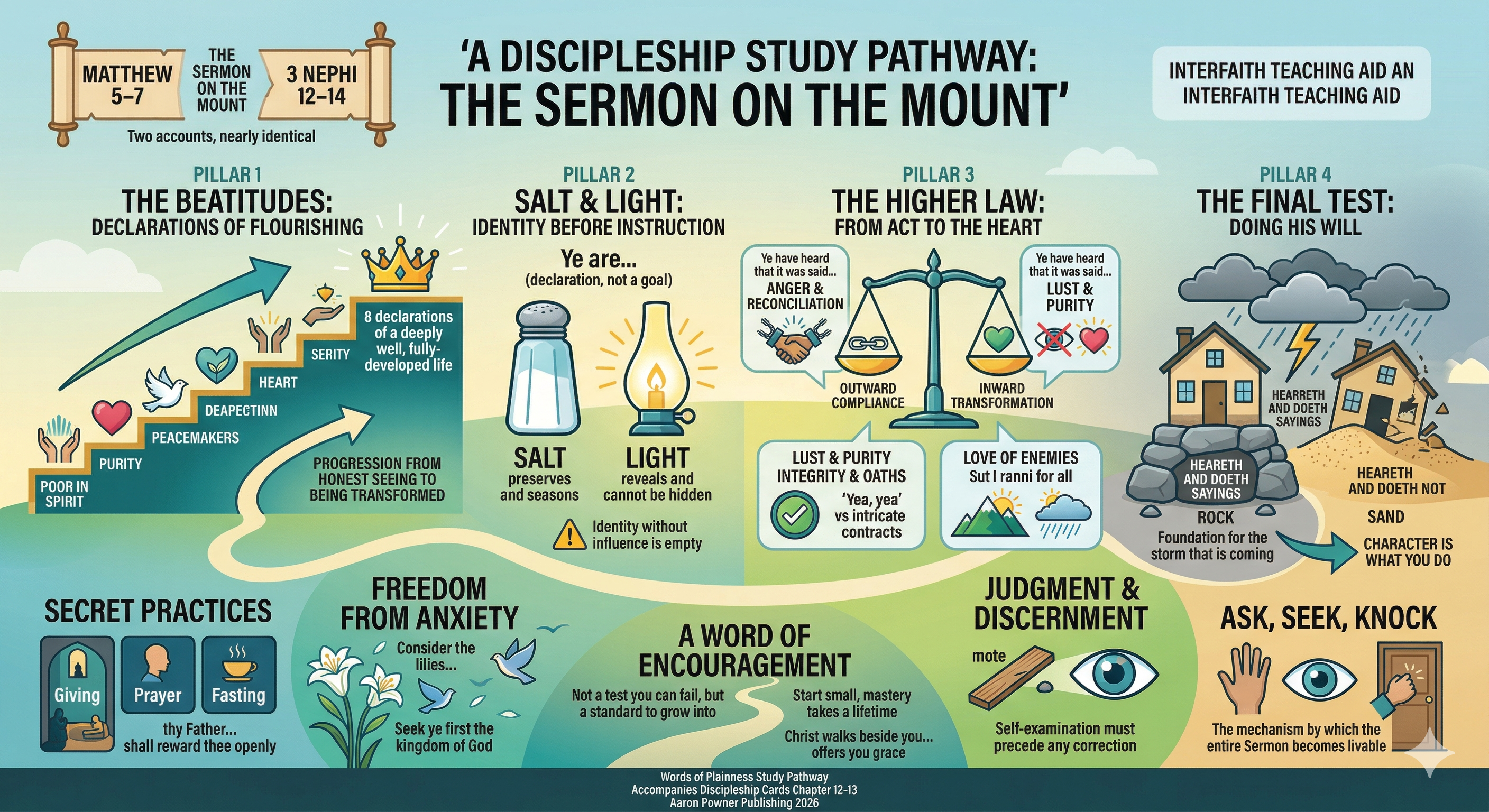
Sermon on the Mount — Summary
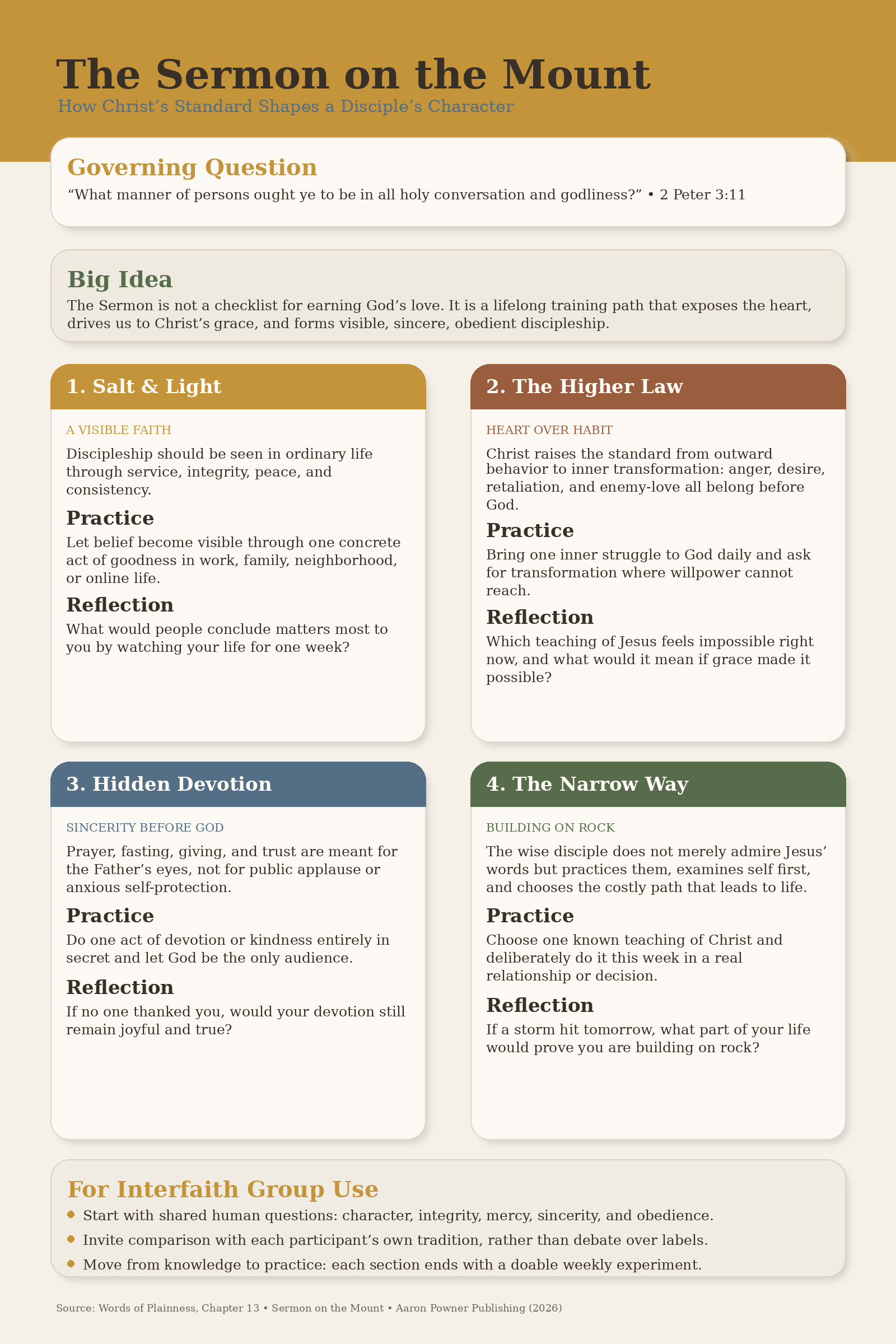
Sermon on the Mount — Discipleship Practices
Continue the Conversation
Ask questions, share insights, and grow together in understanding.