
Chapter 12
The Beatitudes — Christlike Character
"Be ye therefore perfect, even as your Father which is in heaven is perfect." — Matthew 5:48
How This Chapter Works
Each card below explores a practice of discipleship. Read how Latter-day Saints understand and live it, consider how it blesses, then decide how you will practice it in your own life.



The Flourishing Life
What "Blessed" and "Perfect" Actually Mean
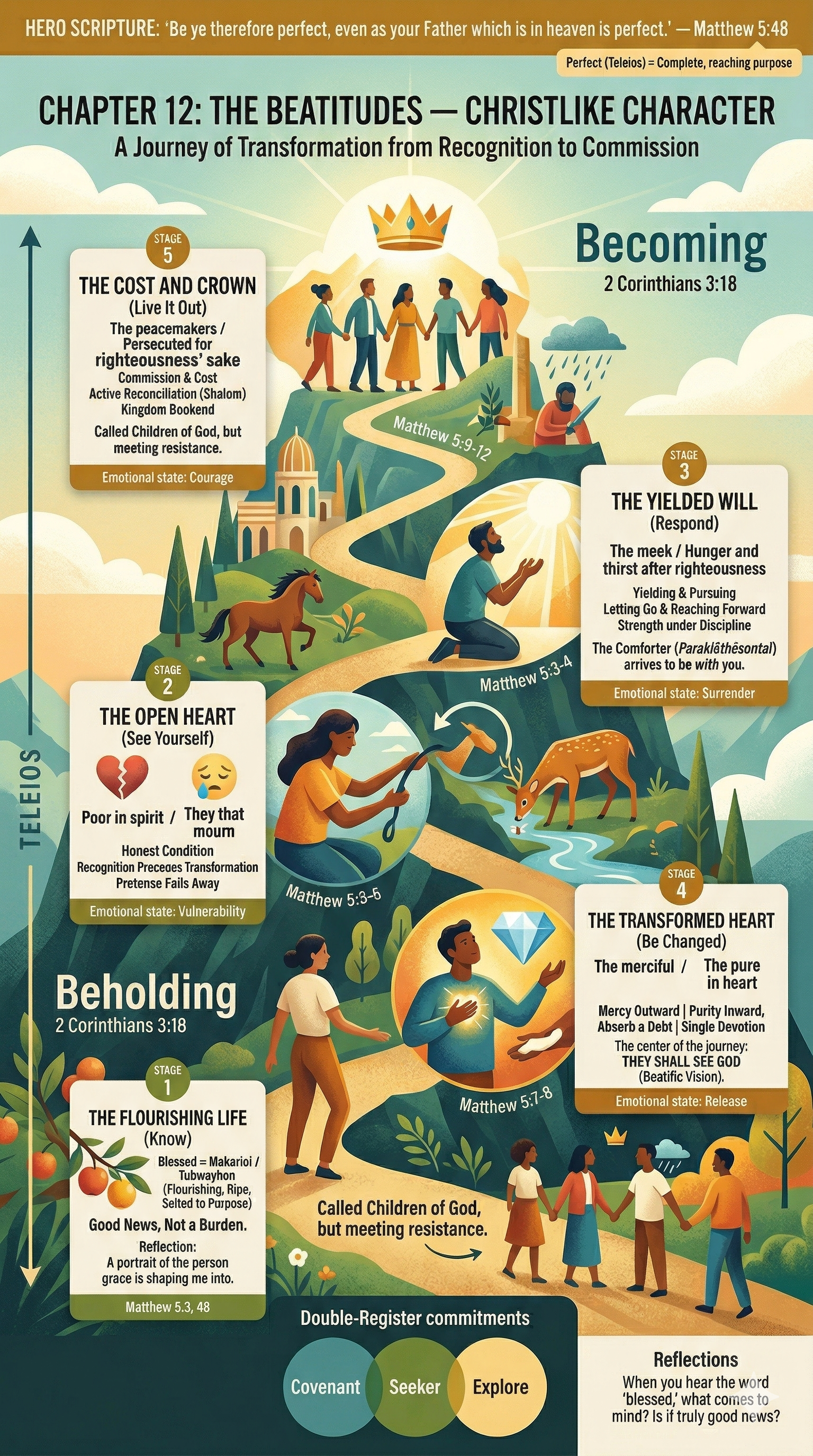
When Jesus ascended the mount and spoke the Beatitudes, He opened with a word that has been softened by centuries of familiarity. The Greek is makarioi—not a pat on the head for good behavior, but a declaration of genuine human flourishing. The Aramaic is even richer: tubwayhon, meaning ripe, mature, suited to your created purpose—like fruit reaching its fullness on the branch. The Latin beati carries "made happy"; the Spanish bienaventurados, "well-adventured." Every ancient tongue converges on the same truth: what Christ is describing is the genuinely good life. The Beatitudes are not a burden. They are good news.
This reframe matters because the same sermon that begins with makarioi ends with a command that has paralyzed generations of earnest disciples: "Be ye therefore perfect, even as your Father which is in heaven is perfect" (Matthew 5:48). The Greek word translated "perfect" is teleios—and it does not mean morally flawless. It means brought to completion, having reached your telos, your purpose. In agricultural usage, it describes fruit that has ripened. In familial usage, it describes a child who has grown to maturity. Christ is not demanding the impossible. He is inviting us to become what we were created to be.
The Restoration witness confirms this reading with a single addition. Where Matthew records "even as your Father which is in heaven is perfect," the resurrected Christ adds: "even as I, or your Father who is in heaven is perfect" (3 Nephi 12:48). He includes Himself—not as a distant ideal but as living proof that teleios is possible in mortal flesh. The kingdom He announces is not far off. It is at hand (Matthew 4:17).
The Relief of Good News
I spent years reading the Beatitudes the way I read a performance review—scanning for where I fell short. Poor in spirit? I was too proud. Pure in heart? Not even close. Peacemaker? I had a temper. Every line felt like another item on a list I could never complete. The Sermon on the Mount was beautiful, but it was crushing me.
The turning point came when I stopped reading the Beatitudes as demands and started reading them as a description of the life Christ was offering. Makarioi—flourishing. Teleios—becoming what I was made to be. Not a checklist of impossible virtues but a portrait of the person grace is shaping me into. The Apostle Paul understood the mechanism: "We all, with open face beholding as in a glass the glory of the Lord, are changed into the same image from glory to glory" (2 Corinthians 3:18). The transformation is real, but it begins with beholding—not with striving.
The four cards that follow walk through the Beatitudes not as a checklist but as a journey—from recognition to response, from transformation to commission. The commitments on the next tab invite you to begin that journey by simply reading the words of Christ with fresh eyes.
Writing Prompt
When you hear the word 'blessed,' what comes to mind—and does it sound like genuinely good news?
The Open Heart
The Courage to See Clearly
"Blessed are the poor in spirit: for theirs is the kingdom of heaven. Blessed are they that mourn: for they shall be comforted" (Matthew 5:3–4). These are the opening words of the Sermon on the Mount—and they are an invitation, not a command. To be poor in spirit is to see oneself honestly before God—not self-hatred, but the kind of clarity that comes when pretense falls away and what remains is need. The Psalmist understood: "The Lord is nigh unto them that are of a broken heart; and saveth such as be of a contrite spirit" (Psalm 34:18).
Mourning follows naturally. When we see our true condition—the gap between who we are and who grace calls us to be—the honest response is sorrow. Not despair, but the grief that opens us to change. The prophet Alma described a community who went through exactly this process: they "humbled themselves and put their trust in the true and living God" (Alma 5:13). Recognition preceded transformation. The open heart is not a destination—it is a door.
Notice the promise attached to these first Beatitudes: "theirs is the kingdom of heaven." Not "theirs will be someday." Is. Present tense. The kingdom belongs to the one who has stopped pretending and started seeing. This is the first movement of discipleship—not strength, but honesty.
What Honesty Unlocked
There was a season when I thought spiritual maturity meant having my life together. I prayed confidently. I served faithfully. I kept the commandments. And beneath it all, I was quietly terrified that if anyone saw what was really going on inside me—the doubts, the exhaustion, the anger I could not explain—they would conclude I was failing. So I performed.
The break came not in triumph but in collapse. I ran out of the energy required to maintain the performance. And in that emptiness, something unexpected happened: God showed up. Not with a lecture—with comfort. The promise of the second Beatitude is specific: "they shall be comforted." The Greek paraklēthēsontai carries the sense of being called alongside—the very word Christ used for the Holy Spirit (John 14:16). The Comforter does not arrive to fix you. He arrives to be with you—and in that presence, healing begins.
Whether your heart is already open or still guarded, the commitment on the next tab invites you to take one step toward honest seeing. Christ promises that the kingdom belongs to those who do.
Writing Prompt
Is there something you have been carrying alone that might lighten if you named it honestly—to yourself, to God, or to someone you trust?
The Yielded Will
Two Movements of the Same Turn
"Blessed are the meek: for they shall inherit the earth. Blessed are they which do hunger and thirst after righteousness: for they shall be filled" (Matthew 5:5–6). These two Beatitudes belong together because they describe two movements of the same turn. Meekness is the yielding—the willingness to let go of control, to stop insisting that our way is the right way, to become teachable before God. Hunger is the pursuing—the active, aching desire for what is right, what is true, what is of God. Together, they are the engine of repentance: letting go and reaching forward in the same motion.
Meekness is often misunderstood as passivity. It is not. In the biblical tradition, the meek are those who possess great strength under great discipline. Moses was called "very meek, above all the men which were upon the face of the earth" (Numbers 12:3)—and this was the man who confronted Pharaoh, led a nation through the wilderness, and spoke with God face to face. Meekness is not the absence of power. It is the refusal to use power for self.
Hunger completes what meekness begins. The yielded heart does not remain empty—it reaches. "As the hart panteth after the water brooks, so panteth my soul after thee, O God" (Psalm 42:1). This hunger is not a sign of failure. It is the surest sign that grace is at work. The soul that hungers for righteousness is already being drawn toward the One who satisfies.
The Strength in Surrender
I am a stubborn man by nature. Yielding does not come easily to me. For much of my life, I confused meekness with weakness—and because I feared weakness, I resisted the very thing that could have freed me. I held onto opinions, habits, and grudges with a grip I mistook for strength.
The turning came slowly. It was not one dramatic moment but a series of small surrenders—each one costing me something I thought I needed and giving me something I did not know I lacked. Each small act of yielding opened space for hunger—a genuine desire for God that I had been too full of myself to feel. The promise is that the hungry shall be filled. I can testify: He fills. Not all at once, and not always in the way we expect—but with a steadiness that the self-directed life never provides. Be a little kinder. Be a little more humble. Be a little more prayerful. The small steps accumulate into a life that is being completed.
Meekness and hunger are not opposites. They are partners—the open hand and the reaching hand. The commitment on the next tab invites you to practice both.
Writing Prompt
Where in your life right now are you holding on the tightest—and what might happen if you loosened your grip?
The Transformed Heart
Mercy Outward, Purity Inward
"Blessed are the merciful: for they shall obtain mercy. Blessed are the pure in heart: for they shall see God" (Matthew 5:7–8). These two Beatitudes mark the interior turn of the Sermon—the point where discipleship moves from what we do to who we become. Mercy is the outward expression: seeing another's need and responding with compassion rather than judgment. Purity of heart is the inward reality: a heart undivided in its devotion to God, free from the double-mindedness that tries to serve two masters.
Mercy is not tolerance—it is costly. To be merciful as Christ is merciful means absorbing a debt we did not create. "Be ye therefore merciful, as your Father also is merciful" (Luke 6:36). The Father's mercy cost the life of His Son. Our mercy—forgiving the grudge, extending patience to the difficult, choosing kindness when it is not deserved—costs us something real. But the promise is reciprocal: mercy given becomes mercy received.
Purity of heart carries the most staggering promise in the entire Sermon: "they shall see God." This is the center of the Beatitudes—the climax toward which every preceding Beatitude has been building, and from which every following Beatitude flows. The pure in heart do not merely know about God. They behold Him. And as the Apostle Paul taught, beholding transforms the beholder: "We all, with open face beholding as in a glass the glory of the Lord, are changed into the same image" (2 Corinthians 3:18).
What Mercy Costs and What Purity Sees
I carried a grudge against a family member for years. I had good reasons—or so I told myself every time the memory surfaced. The debt was real, the wound was real, and my refusal to forgive felt like justice. What I did not see was what it was doing to me. The grudge occupied a room in my heart that nothing else could enter—not peace, not joy, not the Spirit's quiet voice.
Releasing it did not happen all at once. It happened the way most spiritual breakthroughs happen—in an ordinary moment of prayer when I finally said, "I cannot carry this anymore." The relief was immediate and physical. I understood, in my body, what the Psalmist meant: "Create in me a clean heart, O God; and renew a right spirit within me" (Psalm 51:10). Purity of heart is not the absence of struggle. It is the presence of a single devotion that refuses to let anything else occupy the center.
Mercy and purity are not separate achievements. They grow together—the heart that forgives outward is the same heart being purified inward. The commitment on the next tab invites you to let both begin.
Writing Prompt
If purity of heart means undivided devotion, what is the one thing most competing for the center of yours?
The Cost and Crown
Sent into the World as He Was Sent
"Blessed are the peacemakers: for they shall be called the children of God. Blessed are they which are persecuted for righteousness' sake: for theirs is the kingdom of heaven" (Matthew 5:9–10). The final Beatitudes move from interior transformation to outward commission—and they come with a cost. Peacemaking is not passive. It is not avoiding conflict or pretending disagreement does not exist. Biblical peace—shalom—is the active work of reconciling what is broken: relationships, communities, the distance between a soul and its God. "God was in Christ, reconciling the world unto himself... and hath committed unto us the ministry of reconciliation" (2 Corinthians 5:18–19).
The reward for peacemakers is the highest title in scripture: "children of God." Those who do the reconciling work of the Father are recognized as His own. But Christ does not promise that this work will be safe. The next Beatitude is persecution—and the word "for" connects them directly. "Blessed are they which are persecuted for righteousness' sake." The faithful disciple who makes peace, speaks truth, and lives the Beatitudes will meet resistance. Christ knew this because He lived it. The world does not always welcome the light (John 3:19).
Notice that the closing promise circles back to the opening: "theirs is the kingdom of heaven"—the same words that began the Beatitudes in Matthew 5:3. The journey that started with the open heart ends with the tested heart, and both receive the same inheritance. The kingdom belongs to the one who starts and to the one who endures.
The Crown That Costs
I have learned that the call to peacemaking often means standing between two parties who would both prefer you to take their side. It is uncomfortable work. In my years of interfaith ministry—in virtual reality gatherings, in comment threads, in private conversations—I have watched the peacemaker absorb misunderstanding from every direction. People who seek reconciliation are often accused by both camps of betraying the cause.
But I have also watched what happens in the room when genuine peace is made. Something lifts. Something heals. The Apostle James understood: "The fruit of righteousness is sown in peace of them that make peace" (James 3:18). Peace is not the absence of conflict. It is the fruit that grows when someone is willing to absorb the cost of reconciliation—just as Christ absorbed the ultimate cost on the cross. The Beatitudes do not promise comfort. They promise something better: the kingdom of heaven, and the identity of a child of God.
The journey through the Beatitudes has moved from seeing clearly to responding, from being transformed to being sent. The commitment on the next tab invites you to step into the most costly—and most Christlike—work of all.
Writing Prompt
What would it cost you to be a peacemaker in the place where conflict feels most personal?
My Chapter 12 Commitments
Your choices are saved here as you work through each card
How confident are you in these commitments?
Rate your readiness to follow through this week
Musical Testimony
An original song by Aaron Powner, inspired by the themes of this chapter.
What You Were Made to Be
A musical testimony on the Beatitudes as Christ's invitation to flourish — from honest seeing to costly peacemaking.
View Lyrics
Lyrics as sung in the Acoustic Worship arrangement
[Verse 1]
I read the Bee-attitudes like a list of things I'm not—
Every line a mirror showing everything wrong inside me.
"Be ye therefore perfect" kept me striving, kept me small,
Till I learned the word means finished—not "you'd better never fall."
[Pre-Chorus]
Blessed means flourishing—that's the word He chose.
Not "make yourself worthy," not "put on better clothes."
It's the life that's genuinely good, the life He came to give—
Not a standard you can't reach, but a way to truly live.
[Chorus]
This is what you were made to be—
Not flawless, but completed—not fallen, but free.
The kingdom is yours. The kingdom is now.
He's finishing what He started—let me show you how.
[Verse 2]
It starts with honest seeing—poor in spirit means you're real.
You stop the performance, drop the mask, and say the things you feel.
The Lord is near the brokenhearted—that's the door that lets Him in.
And comfort isn't fixing you—it's God beside you as you grow.
You can loosen up your grip—meekness isn't being weak.
Strength governed by discipline, power restrained by wisdom.
And the hunger runs in you like a river going dry—
The soul that thirsts for righteousness will never be denied.
[Chorus]
This is what you were made to be—
Not flawless, but completed—not fallen, but free.
The kingdom is yours. The kingdom is now.
He's finishing what He started—let me show you how.
[Bridge]
Mercy costs you something—it always does, it always will.
It owns debts it didn't earn, love that satisfies justice.
But the pure in heart—they'll see Him.
They'll see Him.
Beholding changes everything—from glory into glory.
His image in your countenance, created in His image.
[Verse 3]
Now He sends you out as peacemaker—the highest name He gives.
Not avoiding all the conflict, but in the middle of it—this is how He lives.
The road will cost you something—the faithful always pay—
But "theirs is the kingdom of heaven"—the same words from His sermon.
The heart that was broken is the heart that now endures.
The grip you finally loosened—now the open hands are yours.
[Final Chorus]
This is what you were made to be—
Not flawless, but completed—not fallen, but free.
The kingdom is yours. The kingdom is now.
He finished what He started. He showed us how.
[Outro — spoken, over descending cello]
You were made for this.
Not perfection—completion. Not flawless—flourishing.
The journey is the becoming. And He promised to finish it.
In the name of Jesus Christ. Amen.
Visual Summary
Continue the Conversation
Ask questions, share insights, and grow together in understanding.