He Is Not Gone
They stood on a hillside in Galilee and watched Him go.
He was gone from their sight. And they stood there, necks craned, staring at the place in the sky where He had been — until two men dressed in white appeared next to them and asked them why they were still looking up. "This same Jesus, which is taken up from you into heaven, shall so come in like manner as ye have seen him go into heaven".
Theirs was the most human response imaginable. You would have done the same. So would I. When someone you love disappears from sight, you stand in the last place you saw them and you hold tight, you hardly breathe, because moving on feels like admitting they are gone — and then the grief begins.
But the angels were not being unkind. They were redirecting sorrow that had no place in their hearts. Because what had just happened was not loss. It was part of something larger than any of them understood yet.
When He ascended — when the cloud received Him — something changed. The promise He had made in that upper room could now be kept: "I will pray the Father, and he shall give you another Comforter, that he may abide with you for ever".
The Ascension was not departure. It was the fulfillment of His promise that they would not be left as orphans.
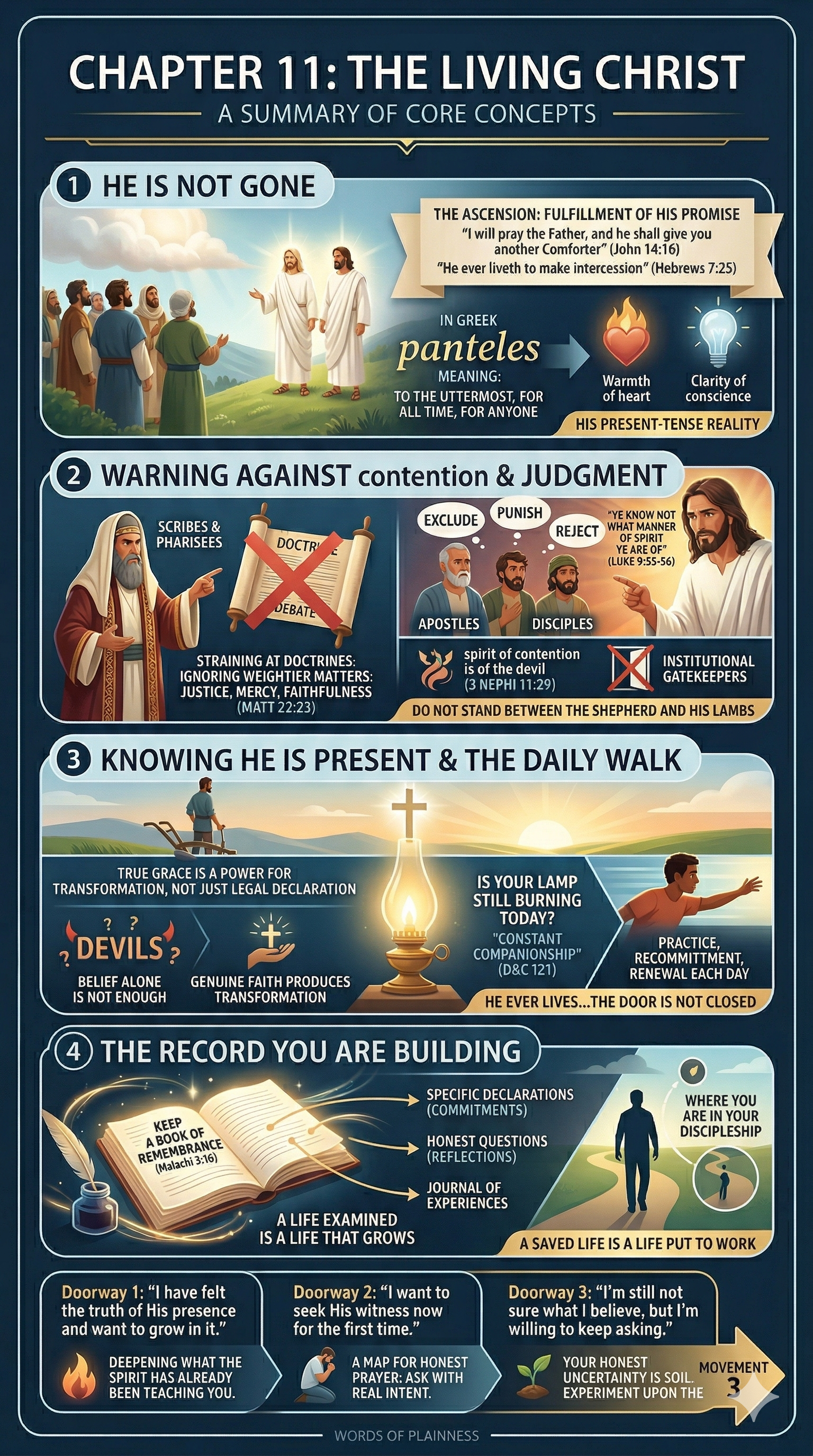
He lives. That is not a theological proposition — it is a present-tense fact. "He ever liveth to make intercession". Right now, in whatever moment you are reading this, He is not resting from the work He finished at Calvary. He is actively interceding for you. The writer of Hebrews uses a single Greek word that has no satisfying English equivalent: panteles — to the uttermost, completely, for all time, for anyone. No exceptions written into the text. No institutional gatekeepers implied. He receives ANYONE who comes to God through Him.
The disciples on that road to Emmaus had been walking with Him for miles — hearts heavy, hope extinguished. They did not recognize Him; not until He broke the bread. And when He vanished from their sight they turned to one another and said: "Did not our heart burn within us, while he talked with us by the way?" They had been in His presence and not known it. The burning was real before the recognition came.
That burning is not a historical artifact. It is available today, in whatever road you are walking, in whatever conversation you did not expect to find Him in. He is not gone. He is present always, everywhere, for everyone.
The chapters ahead of us are designed to develop the capacity to recognize and follow Him.
Clear Warning to the Self-Righteous
One thing must be stated in words of plainness before we move on to the study of discipleship.
There are too many Christians and theologians who spend more energy arguing about who has the right access to Christ than actually seeking Him. Disputes over baptism, membership, creeds, Christology, theology, bibliolatry, traditions, and denominations consume energy that belongs to the things that actually matter. This ministry is not in the business of adjudicating those arguments. We refuse to participate in them. And we will tell you plainly why.
Remember the Lord's condemnation of Scribes — the experts in scriptures — and Pharisees — the religious leaders — who strained at doctrines and debated the fine details of God's law yet ignored the weightier spiritual things that matter most to the Lord: justice, mercy, and faithfulness.
They were meticulous about being right, but they were catastrophically wrong about what mattered. What is the point of this topic?
God's fury was and still is multiplied toward those who attempt to stand between Him and the people who seek Him — the same fury that burned against the Pharisees who stood as gatekeepers of heaven, shutting up the kingdom against others. Christ said of them: "For ye neither go in yourselves, neither suffer ye them that are entering to go in". Read that again. They were not merely failing to see the kingdom of God for what it is, they were blocking the entrance for people who were trying to get in. And Christ named them for what they were: blind guides, pretenders, fools, full of extortion and excess and iniquity, righteous in appearance but inwardly unclean, children of hell, vipers, persecutors of the faithful, spiritually desolate. These are not our words or doctrines. They are His. We would quake at the thought of earning a single one of those judgements of God.
But this was not only the Scribes and Pharisees. Christ corrected this same impulse in His own disciples — in the men who loved Him most.
When the Apostles encountered a man casting out devils in the name of Jesus, they tried to stop him — because he was not one of them. He was outside their circle. He was not credentialed. He did not follow with them. Christ rebuked them: "Forbid him not: for there is no man which shall do a miracle in my name, that can lightly speak evil of me. For he that is not against us is on our part". The man was doing the work of God, and the disciples wanted to shut him down because he did not carry their same membership. Christ would not allow it.
On another occasion, when a Samaritan village refused to receive Him, the Apostles James and John wanted to call fire down from heaven to consume them. The Lord turned and rebuked His own beloved disciples fiercely: "Ye know not what manner of spirit ye are of. For the Son of Man is not come to destroy men's lives, but to save them". Think carefully about what He said. He did not rebuke the Samaritans for their rejection. He rebuked His disciples for their response to it. The impulse to exclude, to punish, to destroy those who do not receive Christ the way we think they should — that impulse is not from Him. He named it. He rejected it powerfully. And He told them they did not even understand the evil spirit they were operating under.
The Restoration confirms this in language so sharp it cannot be misunderstood: "He that hath the spirit of contention is not of me, but is of the devil, who is the father of contention". Not merely unwise. Not merely unkind. The spirit of contention is identified by its source. It comes from the adversary of God. Any minister, teacher, theologian, or believer who carries that spirit into the work of Christ is carrying the wrong fire into the temple.
Paul commanded Timothy in the plainest terms: "The servant of the Lord must not strive; but be gentle unto all men, apt to teach, patient". And to the saints in Rome, who were fracturing over matters of practice and conscience, he asked the question that should silence every self-appointed gatekeeper in every generation: "Who art thou that judgest another man's servant? to his own master he standeth or falleth. Yea, he shall be holden up: for God is able to make him stand". That person you are judging does not answer to you. They answer to Christ. And Christ is able to hold them up without your impotent permission.
Thankfully — mercifully — Christ is able to save to the uttermost anyone who comes to God through Him. That is the doctrine that matters. The Greek word Panteles — completely, for all time, for anyone. No exceptions written into the text. No institutional gatekeepers implied. If He can save to the uttermost, then no human institution and no teacher and no creed and no tradition has the authority to narrow that door. The door is His. The judgment is His. The salvation is His. We must stand aside or face God's wrath.
Stop looking sideways at other Christians. Stop being adversaries to the work of God.
The best example of Christlike humility in these matters was given by the Apostles themselves at the Last Supper. When the Lord told them that one among them would betray Him, they did not narrow their eyes and look suspiciously at one another. They did not point fingers. They did not begin the work of accusation. Instead, each of them — sorrowful, searching, humbled — asked the Lord, "Is it I?"
That is the question. Not "is it him?" Not "is it that denomination?" Not "is it those people whose theology I find deficient?" The righteous example was this: "Lord, is it I?" Their righteous instinct was self-examination rather than accusation. That instinct is the mark of a true disciple. And the absence of that instinct — the readiness to judge others rather than examine yourself — is the mark of the Pharisees whom Christ condemned.
Look to Christ. And look to yourself as His disciple. Do not dare to judge the beliefs or sincerity or quality of faith of others. Let God judge. Leave salvation and condemnation in His righteous hands — hands that still bear the marks of what it cost Him to save you as well as the people you foolishly reject.
Do not dare to interfere with another's spiritual journey. Every soul who seeks Christ is under His protection. Every one of them is precious to Him. Christ expressed His fierce protective nature over all who seek Him, and His warning to those who would harm seekers is the most terrifying sentence He ever spoke: "But whoso shall offend one of these little ones which believe in me, it were better for him that a millstone were hanged about his neck, and that he were drowned in the depth of the sea".
If any part of this warning offends you in the least degree, good! It was intended as a call to Christlike love, a call to repentance from contention and judgment that would not offend the pure in heart.
Again, in the name of Jesus Christ, I call to you with an intensity borne of the Spirit of God that causes me to tremble as I write this.
Do not stand between the Shepherd and His lambs. You will not survive the encounter.
A curated pathway through 30+ scriptures on the warning above
Open Study Pathway →How to Know He Is Present
Okay, now breathe. Pray for God's Spirit to be with you.
You have followed Christ this far. That matters. The search itself is evidence of something alive in you — a hunger the world cannot satisfy and that you have not been willing to ignore. That is the beginning of faith, and it is not nothing.
But beginnings are not endings. The scriptures are honest about what a faith that stops at the beginning eventually produces, and to leave that unspoken here would be a kindness that harms.
There are people who carry the name of Christ without carrying His cross. Who profess Him with their mouths and contradict Him with their lives. This is what it means to take His name in vain.
Paul's words for this are not gentle: detestable, disobedient, unfit for any good work. The Savior's image is equally direct — the hand on the plow, the eyes looking backward. That person, He says, is not fit for the Kingdom of God. Not because He refuses them, but because they have refused the work.
The most sobering verse on this subject does not describe an atheist. It describes a believer. "The devils also believe — and tremble".
Belief alone, without the transformation genuine faith produces, is not a safe place to stand. A mind and conscience shaped over time by unbelief gradually loses its capacity to perceive truth clearly. That mind becomes, in Paul's word, defiled. To profess Christ without the commitment to become Christlike is not a mild shortcoming. It is a trajectory, and trajectories have destinations.
This is where grace enters — not as a way around the warning, but as the answer to it. The grace of Christ is not a legal declaration that leaves a person unchanged. It is a power for transformation, available to anyone who cooperates with it. "If a man therefore purge himself from [sins], he shall be a vessel unto honour, sanctified, and meet for the master's use, and prepared unto every good work". The vessel must be cleansed to be fit for honorable use. That cleansing is not something done to you once. It is something done in you, ongoing, through the daily choices of a soul that is actually trying and repentant whenever falling short of the glory of God.
The practice that makes this possible is not complicated. It is a lamp kept trimmed. Not "has my lamp ever been lit?" but "is my lamp still burning today?"
The question is not whether you had a conversion experience years ago. It is whether the Comforter is present in your living right now. "He shall teach you all things, and bring all things to your remembrance". "Let virtue garnish thy thoughts unceasingly; then shall thy confidence wax strong in the presence of God... The Holy Ghost shall be thy constant companion". The promise of His constant companionship is real. But it is conditional — not on perfection, but on the direction of a life that is genuinely, daily, turning toward Him.
What does His presence feel like in a life that is attending to it? Warmth of heart. Clarity of conscience. A pull toward goodness and away from darkness. A growing capacity to recognize the true value of others. When those things are absent — that is the signal. Not for despair, but time for a return.
This ministry exists so that no one leaves it trembling. The warning above is not the destination — it is the diagnosis that makes the remedy urgent. He ever lives to make intercession. The door is not closed. The plow is still in the field. Whatever looking-backward has happened, the choice to turn forward is available today. The goal of this ministry is to build momentum in choosing how to walk uprightly before God and all the world — practice, recommitment, renewal each day — enduring in faith.
The card chapters ahead are that momentum, made concrete.
The Record You Are Building
Okay, now just breathe.
Pray for the Spirit of God to comfort and encourage you. Let us turn again to the peaceable things of God's Kingdom.
The disciples kept records. The early church kept records. The scriptures themselves are the accumulated record of souls who entered into covenants with God — their prayers, their witnesses, their failures, their restorations. "Then they that feared the Lord spake often one to another: and the Lord hearkened, and heard it, and a book of remembrance was written before him". Also, "We talk of Christ, we rejoice in Christ, we preach of Christ, we prophesy of Christ, and we write according to our prophecies".
We invite you to keep the same kind of record. This website was created as a tool for doing so. Not for publication, not to prove anything to anyone — but because a life examined is a life that grows, and because the record you make today will speak to you years from now with a clarity that memory alone cannot provide.
The card chapters ahead are not a curriculum for people who have already arrived at perfection. They are designed to support the daily work of people who have decided to keep moving forward in faith. Each card teaches one practice of discipleship — what it looks like, what it produces, and what it asks of you. Each commitment tab invites you to make a specific declaration: not what you believe in the abstract, but what you will actually do, in the week ahead, with what you have received. Each reflection prompt is a question worth sitting with honestly.
As you work through them, the Words of Plainness app system builds a personal account of where you are in your discipleship — your choices, your goals, your witnesses, your honest questions. You can save it to your free registered account, or download it, share it with your religious leaders or the people who matter most to you, or hold it privately. It is your record, your discipleship tool. What you do with it is between you and God.
When Peter stood on a shoreline after the resurrection and Christ asked him three times whether he loved Him, the answer Christ gave to each declaration was not a blessing — it was an assignment. Feed my lambs. Feed my sheep. A saved life is not a life that has been declared clean and left to sit. It is a life put to work. The card chapters ahead are the natural work that accompanies faith.
You have followed Him this far. It is time to self-assess. What do you feel?
All seekers arrive at this threshold from different places. There are now three doorways before you with one destination. The record you build is yours regardless of which door you enter.
Self-Assessment Before Moving On
You already know what the burning feels like. You have felt it — in prayer, in scripture, in a moment you did not plan for. The card chapters ahead are not an introduction to something unfamiliar. They are a deepening of what the Spirit has already been teaching you.
Use them to formalize what is already forming. Let the commitment tiers give language to what you are already attempting. Let the reflection prompts draw out what you have been carrying silently. Let the journal become the record Malachi described — the book of remembrance written for those who fear the Lord and think upon His name.
Welcome. Enter Movement 3 →
You do not need to already believe. You need to be willing to ask honestly. That willingness is enough to begin.
Moroni wrote to readers who had not yet received a witness: "Ask God, the Eternal Father, in the name of Christ, if these things are not true; and if ye shall ask with a sincere heart, with real intent, having faith in Christ, he will manifest the truth of it unto you, by the power of the Holy Ghost". The promise is not made to the theologically prepared. It is made to the sincere seeker of truth.
Before you enter the card chapters, find a quiet place and a quiet moment.
There is no wrong way to pray. But it does require one to be brave enough to accept what it means to receive an answer. Be humble. Be sincere. Quiet your mind, emotions, and body. Be patient. Find the innermost part of who you are. Direct your thoughts and emotions to God. Reach out with a sincere desire to connect with God, the source of light and truth.
Address Him. Whatever name for God feels most true to you right now — Heavenly Father, God, Father — use it. He knows you. He has been waiting for this conversation.
Speak from your heart. Tell Him what you have read. Tell Him what you are not sure about. Tell Him what you desire to know. This is not a dramatic performance. Do not be eloquent. Be plain. He is not impressed by vocabulary. He is moved by honesty. Ask the question you actually have, not the question you think you are supposed to have.
What follows is not a script — it is a map of what an honest prayer of salvation might look like.
Ask God to help you feel the reality of His spirit and power. Open your heart to this, exerting true desire. Be willing to accept an answer and all the obligations that come with it.
Ask God if Jesus Christ was truly His divine Son. Did He really suffer for your sins, die on the cross for you, and resurrect to immortal glory?
Ask God if you should believe in Christ and follow Him.
Stay quiet and listen with an open mind and heart.
If you feel nothing at first, don't give up. Study, think, and pray again the next day. Let yourself continue to desire a witness from God.
Then continue to live your life — and pay attention. Not just in the next five minutes. In the days and weeks that follow. The answer may come as warmth. As clarity. As a thought that arrives unexpectedly and does not feel like your own. As a conversation you did not arrange. As a verse that stops you mid-sentence. He answers in His own way, in His own time. But He does answer an honest seeker.
When you do feel God's power, embrace the moment. Sit with it.
Express gratitude in prayer to God for His answer.
Confess to Him that you now truly believe in Jesus Christ as your Savior.
Ask for forgiveness of your sins.
Invite God to come into your heart to help you follow the Savior.
Close in the name of Jesus Christ.
If you would rather form your own prayer than follow a map, use these elements: an honest address, an honest account of where you are, a specific question, and a willingness to notice what follows. That is all that is required.
If you have done these things. Welcome. Enter Movement 3 →
That willingness is not a small thing. Do not underestimate it.
Alma wrote to people in exactly this condition: even if ye can no more than desire to believe, let this desire work in you. The seed does not need to have already sprouted for you to plant it. It needs soil. Your honest uncertainty, held with genuine openness, is soil.
The card chapters ahead do not require prior conviction. They invite honest engagement. Each practice, approached with real attention, has a way of teaching its own truth over time. The fruit is the evidence. You do not have to declare anything before you have seen it.
Use the reflection prompts to record what you are actually experiencing — not what you think you should be experiencing. The questions are open-ended for exactly this reason. There are no wrong answers in an honest journal. There are only honest ones.
Some seeds take longer to sprout than others. The timing is not yours to control. Plant it anyway, and tend what grows.
You are who Alma was speaking to when he challenged us to experiment upon the word of God. Christ Himself proposed the terms of the experiment, saying, "He that hath my commandments, and keepeth them, he it is that loveth me…and I will love him, and will manifest myself to him". Test these spiritual principles for yourself.
Welcome. Enter Movement 3 →