For the Joy Set Before Him
His prayer was still in the air when Jesus rose from the table and led His disciples out into the night.
He had just given them everything He had to give in words---the gift of His glory, the promise of oneness with the Father, the intercession on behalf of every soul who would ever come to believe. He had prayed over them with a tenderness the disciples would spend the rest of their lives trying to describe. And then He stood, and He led them through the eastern gate, down into the Kidron Valley, and toward an olive grove where He had often gone to pray.
He knew exactly what waited there for Him.
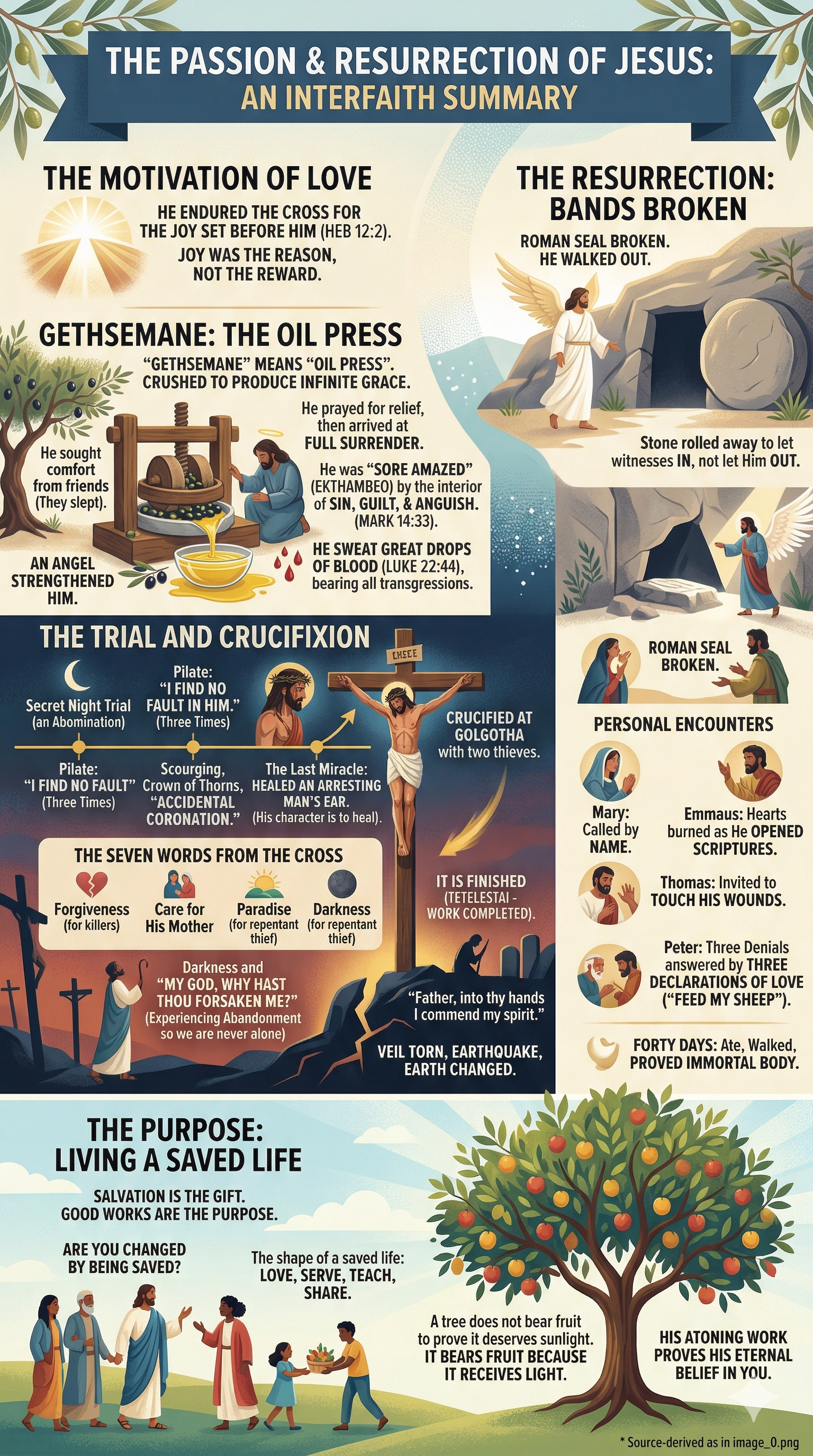
The letter to the Hebrews offers a single line that unlocks the entire night: "who for the joy that was set before him endured the cross." () Joy was not the reward for what He was about to do. Joy was the reason He did it.
The prophet Isaiah glimpsed the full weight of this moment centuries before it arrived. In vision, he saw Jehovah searching the whole sweep of creation---the divine council of heaven, the covenant community on earth---and finding no one capable of stepping into the gap between a broken humanity and the demands of eternal justice. His mighty spirit was appalled by the emptiness. Not one soul among all the heavenly host, not one person in all the generations of Israel, could accomplish what was needed. So the Lord's own arm brought salvation. () He rejoiced in knowing that He would be able to do this thing for us.
What It Cost Him to Know Us
The Aramaic word Gethsemane means "oil press." As the olives from a vineyard must be crushed to produce the same precious oil used to anoint kings, the Anointed Son of God was crushed to produce something infinitely more precious.
Gethsemane was not where He accepted the task of saving us. The garden was where He honored His commitment and fulfilled His anointing. But honoring a decision made in eternity does not make the heavy cost less real in mortality.
In Gethsemane, He asked three disciples to stay near Him---"Watch with me." () This request is extraordinary. He who had created the worlds, who needed nothing from any creature, asked three tired fishermen to simply be nearby. He wanted human company in the hardest moment of His mortal life. They fell asleep.
Three times He went to pray. Three times He returned to find them sleeping. And three times He prayed the same essential prayer to God the Father, refining it from "if it be possible, let this cup pass from me" () to "if this cup may not pass away from me except I drink it, thy will be done." () This progression is not weakness. It is the most honest prayer ever prayed. It began with the natural human plea for relief. And it arrived---through the actual cost of suffering---at full surrender. He did not begin with perfect resignation. He arrived there, after His knees settled into the dirt in a grove, surrounded by an orchard of olive trees. It is the same way every disciple learns surrender to wisdom and righteousness: by choosing it in the dark when the cost is real.
There, on His knees, His pure mind and tender heart began to span all of time and space to perceive each of God's children with miraculous spiritual intimacy. (; ; ; )
Christ's spirit has been present for every moment of the human experience for every human who has ever lived or will ever live upon all of His creations. In the short span of time He spent in Gethsemane, He completed an act of divine empathy, feeling everything we feel, knowing our hearts, feeling our joys and fears, our guilt and pains. Mark used a Greek word to describe the Lord's experience in the garden---ekthambeō. This word is typically translated as "sore amazed" or "greatly distressed." () It is a word used for profound shock, horror, or being frightened---the kind that stops a person in their tracks.
Wait. God was amazed and distressed while on His knees in Gethsemane?
He who had existed before time, who had organized this world and spoken it into order, who walked the streets of Israel healing the sick and raising the dead---this Divine Person was staggered. Not by the simple fear of physical suffering and death yet to come, though that was surely real.
What staggered the Son of God was the recognition of the weight of what sin actually is from the inside of sinners---the guilt, the anguish, the torment that had been utterly foreign to His sinless soul. He had known about human darkness the way a surgeon knows about pain---with precision, from outside the wound. In Gethsemane, He took our wounds within His own spirit.
He was not performing a script. He was encountering something that exceeded even His premortal comprehension. And He endured it anyway, for the joy of saving us all.
An angel appeared to strengthen Him. () Even this is striking---that the Son of God, in the moment of maximum cost, was ministered to rather than simply sustained by divine power alone. The Father sent help. Still, the physical stress of such immortal actions within His mortal flesh was real. Jesus sweat great drops of blood from the pores of His skin, (; ) suffering the full measure of justice for every transgression of every soul from every world He had created as the premortal Jehovah. () His mortal body should have died from the strain, but He chose to live through it. He paid the price for you, specifically, in that garden---your sorrows, your guilt, your accumulated weight---while three disciples slept thirty feet away and had no idea what was happening.
With the Gethsemane portion of the atonement complete, the Lord staggered back to look upon His sleeping disciples with new understanding. Jesus said "the spirit is willing but the flesh is weak." () He woke them gently. "Rise up," He said, "let us go; lo, he that betrayeth me is at hand." ()
In Gethsemane He paid the first and most precious part of the atoning sacrifice---the cost of knowing us---and then He walked toward enemy torchlight coming through the trees.
It was Judas who led them. A kiss to identify Him. Betrayal by affection---a bitter irony.
Peter drew his sword and cut off the ear of one of the arresting party. And here, in the instant of His own arrest, the man Yehoshua performed His last miracle before the Resurrection: He healed the ear of the man who had come to take Him captive. () This is not a footnote. This is the clearest single demonstration of His character in the entire Passion narrative. Arrested, betrayed, facing death---and His first instinct was to heal suffering. The disciples fled, and He did not ask them to stay.
What followed was, in legal terms, an abomination. The Sanhedrin trial was conducted in secret at night, both violations of Jewish law. Witnesses were called whose stories contradicted one another. He was struck in the face while standing before the high priest. He was mocked. He was spat upon. Through it all He answered when the truth required it and went silent when His words would only be weaponized.
The Roman governor over Judea, Pontius Pilate then examined Him privately and came away convinced of His innocence---and said so officially and publicly three times. (; ; ) He offered the crowd the choice to release Him. They asked for Barabbas instead. A murderer went free. The innocent one was scourged.
The soldiers dressed Him in a purple robe and pressed a crown of thorns onto His head and mocked Him as a king. What they meant as degradation was, without their knowing it, the truth. They were dressing the actual King of the universe in the symbols of His own office, offering their contempt as an accidental coronation.
He bore it all. He could have called legions of destroying angels to pour righteous anger upon His enemies in a display of justice that would have been a stark reminder of the plagues of Egypt and the total destruction of Sodom and Gomorrah. He chose a different path.
He Paid the Rest of the Price Alone
They led Him through the streets of Jerusalem carrying the crossbeam, so physically exhausted from the night's ordeal that He could not sustain the weight. Simon of Cyrene was pulled from the crowd to carry it for Him---the only moment in the entire Passion of Christ where a mere mortal bore any portion of His divine burden. The Savior understands what it is to lack strength to bear His cross alone.
Positioned by rough hand upon the timbers of the cross at Golgotha, He refused the wine mixed with gall that the soldiers offered as a painkiller. He needed to face what was coming with full awareness. He let them open His hands---the hands that had touched lepers, broken bread, blessed children, washed feet---and drive the nails.
Pilate ordered an inscription above His head: "Jesus of Nazareth, the King of the Jews." Pilate had found no fault in Him. Romans gave Him back His kingly title when His own people would not. It was the only act of justice the Romans offered, and they placed it in wood above His crucified body. In contrast, the chief priests, scribes, and elders of Israel came personally to the foot of the cross to mock Him. He experienced the sting of betrayal, the hurt of false judgment, and rejection by those who should have known better.
From the cross He spoke seven times.
"Father, forgive them; for they know not what they do." () He was already in the act of being killed when He prayed this---not later, not after the worst was past, but from within it. He had, in Gethsemane, already spanned all of human history and borne what He bore. Now, dying, He interceded for the people killing Him. This is not heroic stoicism. This is the natural speech of someone whose character does not change under pressure---because the pressure of Gethsemane had already confirmed what He was made of.
Upon three crosses that day were hanging three men: one a repentant thief, one the Lamb of God, and one an unrepentant sinner who mocked God. To the repentant thief He said, "Today you will be with me in Paradise." ()
To His mother, He looked down upon her and made practical arrangements. "Woman, behold thy son" and to John "behold your mother"---entrusting her to the beloved Apostle's care. () Even in dying, He noticed the specific human need of one person standing at His feet and acted to meet it.
Then darkness. Near the end, thick darkness gathered---not the darkness of an eclipse, but something felt by the creation itself, lasting for hours. Enoch prophesied that at the very moment of Christ's suffering, the heavens were veiled and all creation mourned. ()
Within the terrifying darkness and silence, Jesus suddenly cried with a loud voice: "My God, my God, why hast thou forsaken me?" () Do not explain this away. Sit in it for a moment before moving on. This is the being who, from before the foundations of the world, had never been separated from His Father. Who had said "I and my Father are one." () Who had prayed, only hours before, "that they also may be one in us"---a unity He knew from the inside, the most fundamental reality of His existence. And now, at the moment of maximum need, in the depths of bearing the full accumulated cost of every human soul's darkness---He heard nothing. He experienced what abandonment feels like. Not as an observer. Not as a comforter from a distance. From inside it. He went to the place of desolation so that no soul who ever cries out in the dark needs to cry out alone. Someone has already been there. Someone knows exactly how loud silence can be---and chose to remain in it until the work was finished.
When it was finished, He did not simply drift into death. He acknowledged His physical suffering: "I thirst." () He recognized that the full price of the atonement had been paid: "It is finished." () The Greek word is tetelestai---a single word that means accomplished, fulfilled, completed. It is the word a craftsman uses when the work is done. Not defeat. Not relief. Completion. Then He turned His voice again to His Father, who only moments before had left Him utterly alone to finish the work: "Father, into thy hands I commend my spirit." () His last words before death invoke the Father by name.
The veil of the temple tore from top to bottom---not from the bottom, as human hands would have torn it, but from the top, as if the hand of God reached down and opened what had been closed since Sinai. The way into the presence of the Father had been opened.
Then the ground shook powerfully, rocks were split into pieces, the Earth changed. In the Western Hemisphere, a continent convulsed: earthquakes, fires, storms, darkness so complete it could be felt. () The creation responded to what was happening on a hill in Jerusalem in ways that cowering humans crowded around the cross could not fully understand. But when a Roman soldier at the feet of the crucified Jesus saw these things, he said, "Surely this man was the Son of God!" ()
The Seal That Cannot Be Broken
Matthew 27:66 records that Pilate's soldiers sealed the tomb with a Roman seal---the official mark of imperial authority---and set a guard. By Sunday morning, the seal was broken, the guard had fled, and the stone was rolled away. The most powerful empire in the world had pressed its mark upon His death and declared it final. He walked out anyway.
The irony is exact and beautiful: the seal of Rome could not hold Him. But the seal of divinity He pressed upon the work of salvation cannot be broken by any power in heaven or earth.
Another breathtaking turn is to realize that the stone was not rolled away from the tomb to let Him out. It was rolled away to let witnesses in. He was already gone.
The first person the resurrected Lord appeared to was Mary Magdalene---alone, weeping outside the tomb in the dark. () The disciples had come and gone. The angels had spoken to her, trying to reassure her broken heart. And still she wept, because explanation was not what she needed. He appeared to her as a gardener---unrecognized, unhurried, asking her a question rather than making a declaration: "Woman, why weepest thou? Whom seekest thou?" () And when she turned, still not recognizing Him, He said one word.
"Mary."
She knew His voice. She had always known His voice, not just in her ears but in her heart. And in that single word---her own name, spoken in that voice, on that morning---every promise He had ever made collapsed into the present tense. He was alive. He knew her name. He had always known her name. The relationship formed in mortality had not been dissolved by death. The specific, unrepeatable bond between this person and this man had outlasted the tomb.
This is what the Resurrection looks like from the ground: not a theological proposition, but a name spoken by someone you thought you would never hear again.
He came next to travelers on the road to Emmaus---two disciples walking away, in grief and confusion, not knowing what to do with their great hope, now broken and dead. () The Lord joined them without revealing Himself. He asked what they were discussing. He let them tell Him everything---their confusion, their crushed expectation that He had been the one who would redeem Israel. He listened. And then, beginning with Moses and working through all the prophets, He opened the scriptures to them. Their hearts burned while He spoke. They didn't know why until they sat down to eat together and He broke bread---the same gesture, the same hands, the same blessing---and their eyes were opened.
"Did not our heart burn within us?" () They had been with Him for hours on the road, and they had not known it. Grace was present the whole time. They had just not recognized the form it was wearing.
To Thomas, who had missed the first appearance and refused to believe without direct evidence, He came again specifically. () He did not rebuke Thomas for his honest doubt. He offered exactly what Thomas had asked for---the wounds in His hands and side. He invited Thomas to touch them. Thomas, the doubter, the one who had demanded proof---collapsed into the most direct declaration of Christ's divinity in all of John's Gospel: "My Lord and my God." The confession that confirmed everything came from the man who had been most honest about his uncertainty.
He restored Peter. Three denials answered by three invitations: "Lovest thou me? Feed my sheep." () He did not allow Peter's shame to be the last word between them. He made Peter say it three times---not to humiliate him, but to displace each denial with a declaration of love. He was thorough in His mercy.
He appeared over forty days. He ate with them. He walked with them. He was not a ghostly vision or a memory. He had a body that could be touched and a voice that could be heard. He must have smiled as He reassured them of this reality.
"Behold my hands and my feet, that it is I myself: handle me, and see; for a spirit hath not flesh and bones, as ye see me have. And when he had thus spoken, he shewed them his hands and his feet. And while they yet believed not for joy, and wondered, he said unto them, Have ye here any meat? And they gave him a piece of a broiled fish, and of an honeycomb. And he took it, and did eat before them." ()
The last miracle of the Atonement was not the empty tomb. It was that He came back to the people who had abandoned Him, denied Him, doubted Him, and wept over Him---and He made a fire on the beach and cooked them breakfast. () He fed His own sheep.
He did not simply survive death. As the God of both the dead and the living, He personally broke the bands of death and miraculously rejoined His flesh to His spirit as an immortal being of power and glory. There is a vast difference between these two things. He was, as He had declared, "the resurrection and the life." () He proved it by exercising that power Himself.
He is the God of Salvation. Not because He survived what no one else could survive---though He did. Because having survived it, He came looking for His disciples. He still comes looking for you.
Saved, and Then What?
Among Christians, a common question asks whether you have been saved. It is a good question---but only the beginning of spiritual life.
The second big question is, "Have you been changed by being saved?"
Grace that is truly received does not leave a person where it found them. It cannot. When the love of God enters a wounded heart, that heart beats differently. Hands that were closed begin to open. Feet that were still begin to move. Paul understood this so well that he answered the question before anyone thought to ask it. In the same passage where he declared that salvation is the gift of God---not of works, lest any man should boast---he continued without pause: "For we are his workmanship, created in Christ Jesus unto good works, which God hath before ordained that we should walk in them." () The gift of verse eight carries the purpose of verse ten inside it.
The third big question is, "What have you been saved for?" Not heaven as a destination, but as a direction and an enduring lifestyle. Not relief from the burden of sin alone, but transformation into the kind of person who bears the burdens of others. He did not say, "If you love me, hold correct opinions about me." He said, "If you love me, keep my commandments." () And then He named the commandments He cared most about: feed my sheep, love one another, serve the least of these, go and make disciples. (; ; ; ) These are not the conditions of salvation. They are the shape of a saved life.
Think of it this way. A tree does not bear fruit to prove it deserves sunlight. It bears fruit because that is what living things do with light. The chapters that follow will ask you to consider what fruit you wish to bear---not to earn what He gave you in that garden, at that cross, on that resurrection morning---but because you have received salvation and His grace is working in you. He did not accomplish all of this so that you would simply believe it. He accomplished it so that you could fulfill the purpose of your creation as a child of God.
These questions are not rhetorical. They are a bridge between everything this chapter has shown and everything the chapters ahead will ask of you.
You have now followed Jesus Christ from the prayer He prayed for you in an upper room in Jerusalem, through the garden where the cost of that prayer became real, through the silence of a cross where He finished paying the price alone, to the morning when He sealed the legitimacy of it all by rising from death and appearing to his followers to comfort and teach them of the promise of resurrection for God's children. Every step was chosen. Every step He took was for the joy of what it would accomplish in you.
The disciples who were changed most completely by what they had witnessed were not the ones who understood it the fastest. They were the ones who let it change the way they lived. Mary went and told what she had seen. The Emmaus disciples went back to Jerusalem immediately and found the others. Peter fed the sheep. Thomas bore witness for the rest of his life to the one declaration that traded his doubts for hope eternal.
The chapters ahead will ask what it looks like to live as someone for whom He did this. Not as a performance or act to put on for show. Not as debt-payment. But as an irrepressible response---the natural fruit of a heart that has actually sat with these events and let them mean something.
He prayed for this moment with you. He still prays for you. He is waiting to see what you will do with it all. More firmly than any disciple can believe in Him, He finished His atoning work to express His eternal belief in you.
In the name of Jesus Christ. Amen.