
Chapter 16
Keeping the Sabbath
"Remember the sabbath day, to keep it holy." — Exodus 20:8
How This Chapter Works
Each card below explores a practice of discipleship. Read how Latter-day Saints understand and live it, consider how it blesses, then decide how you will practice it in your own life.



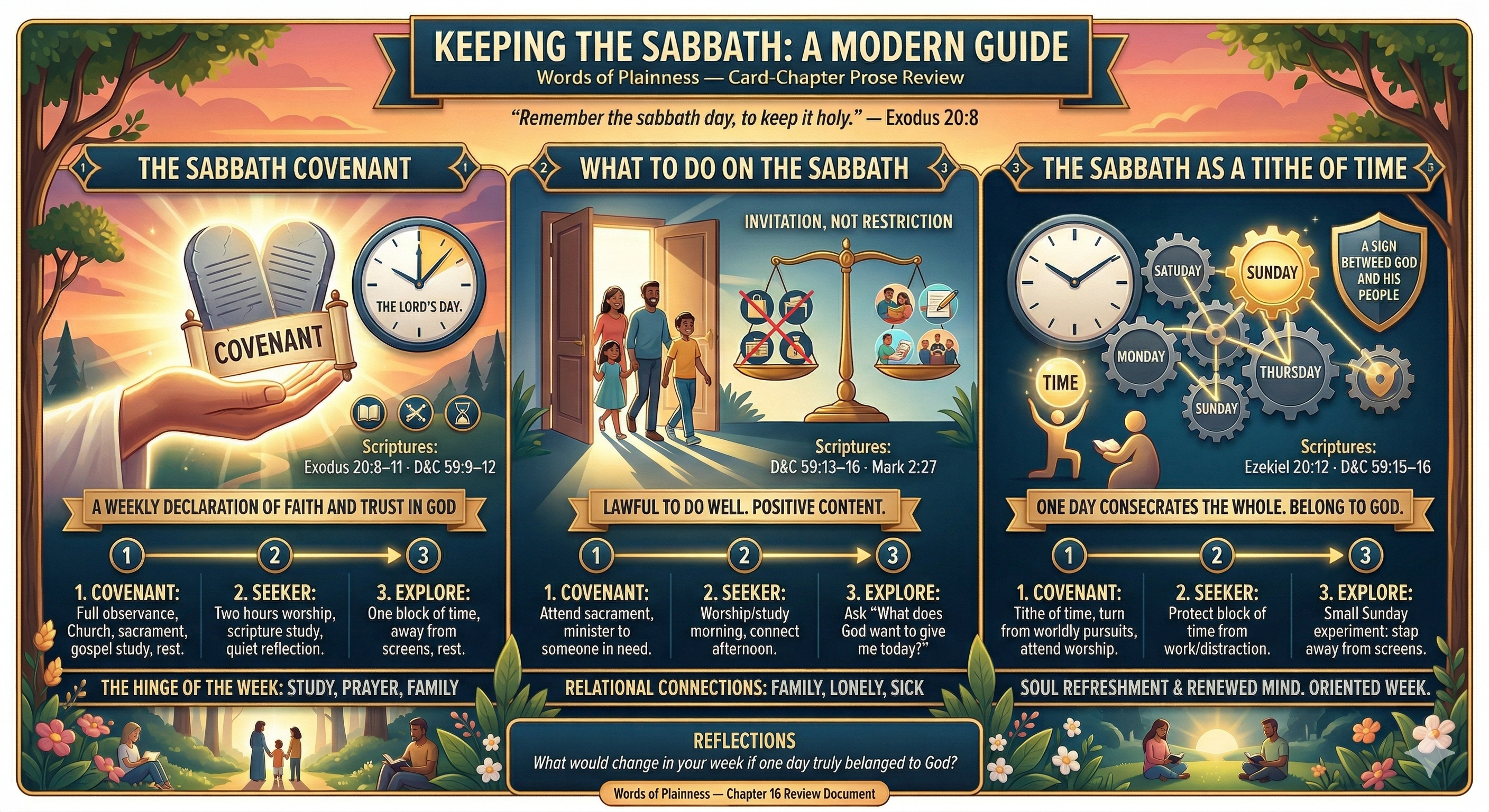
The Sabbath Covenant
A Holy Day from the Beginning
Even God rests from His labors. The scriptural accounts of the Creation record that He "rested on the seventh day from all his work which he had made" (Moses 3:2–3). If the immortal and perfect Creator observed periodic rest and renewal, how much more do His mortal children need a day set apart for Him. In Hebrew, the word is shabbāth—"rest."
One of the Ten Commandments enshrines this practice in the law of God: "But the seventh day is the Sabbath of the Lord thy God: in it thou shalt not do any work... For in six days the Lord made heaven and the earth, the sea, and all that in them is, and rested the seventh day: wherefore the Lord blessed the Sabbath day, and hallowed it" (Exodus 20:10–11). From the days of Adam until the Resurrection of Christ, the seventh day of the week—Saturday—was the Sabbath. When Christ rose on the first day of the week, Sunday became the Lord's Day. Most Christians now observe Sunday as the Sabbath, and modern revelation confirms this is the will of God: "Thou shalt go to the house of prayer and offer up thy sacraments upon my holy day; for verily this is a day appointed unto you to rest from your labors, and to pay thy devotions unto the Most High" (D&C 59:9–12).
The Sabbath is not merely rest from work. It is a covenant—a weekly declaration that God is Lord of our time. When we set this day apart, we are not simply taking a break from the world. We are declaring, once every seven days, whose we are.
The Week That Begins with God
For years I treated Sunday as the day I could not do things. No shopping, no entertainment, no unnecessary work—a long list of restrictions. It felt like endurance, not worship. The shift came when I stopped asking "What can't I do?" and began asking "What does God want to give me today?"
The Sabbath, kept with intent, has become the hinge of my week. Everything before it leads toward it; everything after it flows from it. I study. I pray with less hurry. I sit with my family without a schedule pressing in. The Lord promised through Isaiah, "If thou turn away thy foot from the sabbath, from doing thy pleasure on my holy day; and call the sabbath a delight, the holy of the Lord, honourable... then shalt thou delight thyself in the Lord" (Isaiah 58:13–14). That promise is real. I have tasted it.
Whether the Sabbath is already woven into your rhythm or something entirely new, the commitment on the next tab invites you to set this day apart in a way that fits where you are.
Writing Prompt
What would change in your week if one day truly belonged to God?
What to Do on the Sabbath
A Day of Invitation, Not Restriction
By the time of Christ's ministry, religious leaders in Israel had layered the Sabbath with rules far beyond anything God commanded—tedious restrictions that crushed the very rest the day was meant to provide. The Lord cut through the accumulation: "The sabbath was made for man, and not man for the sabbath" (Mark 2:27). When they accused Him of Sabbath-breaking for healing the afflicted, He answered plainly: "It is lawful to do well on the sabbath days" (Matthew 12:12). The Sabbath was never meant to be a burden. It was designed to be a gift.
Latter-day Saints are taught to approach Sunday not by asking what is forbidden, but by asking what is invited. Modern revelation answers that question with warmth: "And on this day thou shalt do none other thing, only let thy food be prepared with singleness of heart that thy fasting may be perfect, or, in other words, that thy joy may be full... And inasmuch as ye do these things with thanksgiving, with cheerful hearts and countenances, not with much laughter, for this is sin, but with a glad heart and a cheerful countenance—verily I say, that inasmuch as ye do this, the fulness of the earth is yours" (D&C 59:13, 15–16). The positive content of the day includes worship, gospel study, family time, ministering to those in need, letter-writing, acts of kindness—anything that draws us upward and outward rather than inward and horizontal.
The question is not "How little can I do and still keep the Sabbath?" The question is "How fully can I give this day to God and to those He has placed in my life?" The restriction frame and the invitation frame produce entirely different kinds of people.
What the Day Actually Gives
Spencer W. Kimball, a prophet of the Lord, taught that the Sabbath is a time for "attendance at sacrament meeting, for visiting the sick and the bereaved, for writing letters to missionaries, for doing those things that draw families closer together, and for doing those things that are in keeping with the spirit of worship" (Spencer W. Kimball, Faith Precedes the Miracle). What strikes me about that list is how relational it is. The Sabbath is not a private spiritual exercise. It is a day for turning toward people—the congregation, the sick, the lonely, the family gathered at the table.
I have watched the Sabbath teach me things about my children that a Tuesday never could. On an ordinary weekday, we move from task to task and barely look up. On Sunday, there is nowhere to rush. A child's question gets a real answer. A worry gets named. A song gets sung. The unhurried quality of a kept Sabbath is itself a form of witness—it tells everyone in your household that there is something more important than productivity, and that they are part of it.
The commitments on the next tab offer a way to move from enduring Sunday to inhabiting it. Take the step that fits where you are today.
Writing Prompt
When you picture a Sunday that genuinely refreshes you—body, mind, and spirit—what does it look like?
The Sabbath as a Tithe of Time
One Day in Seven Consecrates the Whole
The pattern of tithing is well understood among Latter-day Saints: when we give a tenth of our increase to God, He promises to "open you the windows of heaven, and pour you out a blessing, that there shall not be room enough to receive it" (Malachi 3:10). The Sabbath operates on the same principle, but with time rather than treasure. One day in seven, set apart for God, consecrates the remaining six. The part given to God hallows the whole.
God made this connection explicit when He gave the Sabbath to Israel as more than a rest—it was a sign: "Moreover also I gave them my sabbaths, to be a sign between me and them, that they might know that I am the Lord that sanctify them" (Ezekiel 20:12). The Sabbath was a weekly reminder of who Israel's God was—and equally, of who Israel was. In keeping it, they declared not only that they believed in Him but that they belonged to Him. Latter-day Saints inherit this same sign. When we keep the Sabbath, we are not only resting from labor. We are staking a claim: this day is His, and because this day is His, our lives belong to Him.
The promise attached to faithful Sabbath observance is remarkable in its breadth: "Inasmuch as ye do this, the fulness of the earth is yours" (D&C 59:16). The person who gives one day to God discovers that the other six days carry a quality the seven-day worker never finds.
What the Week Becomes
There was a season in my life when I treated the week as seven identical days, all equally available for work, errands, and getting ahead. Sundays had a slightly different texture—a little quieter, maybe a church meeting—but I did not guard the day. I certainly did not set it apart. Looking back, I can see what I could not see then: I was tired in a way that sleep did not fix. The exhaustion was not physical. It was the exhaustion of a life with no hinge, no holy pause, no day that pointed beyond itself.
We testify, in the name of Jesus Christ, that keeping the Sabbath refreshes the soul and renews the mind. We worship God every day of the week—but we witness that the Lord's Day is a special time of communion with God and brings blessings that come in no other way. The week that begins with God is a different kind of week. Not easier, necessarily—but oriented. Aimed. Lit from the inside in a way that ordinary Sundays are not.
The commitment on the next tab is an invitation to try the experiment: give God one day and see what happens to the other six.
Writing Prompt
If the Sabbath is a tithe of your time, what would it mean to give that day without reservation?
My Chapter 16 Commitments
Your choices are saved here as you work through each card
How confident are you in these commitments?
Rate your readiness to follow through this week
Musical Testimony
An original song by Aaron Powner, inspired by the themes of this chapter.
One Day in Seven
An acoustic worship testimony reflecting on the Sabbath as covenant, gift, and tithe of time.
View Lyrics
Lyrics as sung in the Acoustic Worship arrangement
[Verse 1]
I treated Sunday like a wall—
A list of things I couldn't do.
No shopping, no distractions, nothing fun,
Just getting through.
Then God said something I wasn't ready for:
"This day is not a cage.
It's a gift I've been holding out to you—
Stop fighting it and take it."
[Pre-Chorus]
It's the same thing every parent knows—
A child fights the rest he needs the most.
But the Father sees what we don't see:
We were never built to run all seven days.
[Chorus]
One day in seven—that's the math of heaven.
Give the day to God and watch Him bless the six.
When you stop and worship, everything resets—
Your purpose, your priorities, your peace.
One day in seven. Give it and find out
What the God of heaven does with what you give.
[Verse 2]
I stopped asking what I couldn't do
And started asking what I can.
Now Sunday is the hinge of my whole week.
Everything leads toward this day,
And everything that follows carries what it held.
I study. I worship without a clock.
I sit with the people that I love.
I rest my heart, let it beat for God above.
[Chorus]
One day in seven—that's the math of heaven.
Give the day to God and watch Him bless the six.
When you stop and worship, everything resets—
Your purpose, your priorities, your peace.
One day in seven. Give it and find out
What the God of heaven does with what you give.
[Bridge]
The Sabbath is a tithe—not of treasure, but of life.
One day placed in His hands multiplies the rest.
He said through His prophet, "Call this day a delight"—
I'm telling you right now, that promise is real.
I have tasted it. He's right.
The windows of heaven open when you give Him the day.
[Final Chorus]
One day in seven—that's the math of heaven.
Give the day to God and watch Him bless the six.
When you stop and worship, everything resets—
Your purpose, your priorities, your peace.
One day in seven—even God took rest.
If the Creator stopped, what makes us think we shouldn't?
[Outro]
Rest for a while. He's got your back.
Your Father in Heaven knows your needs better than you.
Visual Summary
Continue the Conversation
Ask questions, share insights, and grow together in understanding.