The Ancient Promise
Countless myths, legends, and folktales across the full breadth of human civilizations relate chosen one narratives. The story arc is always similar: prophecy or destiny, humble beginnings, mentorship, the burden of fate, unique power or lineage, impossible tasks that will defeat a great evil and restore peace and hope. These stories seem to serve an important purpose in the lives of people. But can such a story be true?
Disciples of Jesus Christ witness that this narrative is more than myth—it is a true manifestation of divinity and hope for all humankind.
What is a Messiah? What is a Christ? The first is Hebrew, and the second is Greek. Both mean "Anointed One"—set apart, marked out, chosen for a sacred mission or calling. In the ancient world, anointing was the ceremony that made a king. Oil was poured over the top of the head, and the act declared: this one, and not another.
But the Messiah was not chosen by men. He was chosen by God the Father before the foundations of the earth were laid—appointed to an atoning mission so singular that every age of human history, every covenant and sacrifice and prayer ever uttered by a believing heart, would bend toward it. He would deliver God's children from death and hell. He would become the answer to the deepest thing humanity has ever longed for.
This is not mythology, not legend, not folktale. Disciples of Jesus Christ believe this is the true story of the God of all creation.
From the moment humankind left paradise, God began revealing His plan to redeem us from our necessary journey through mortality.
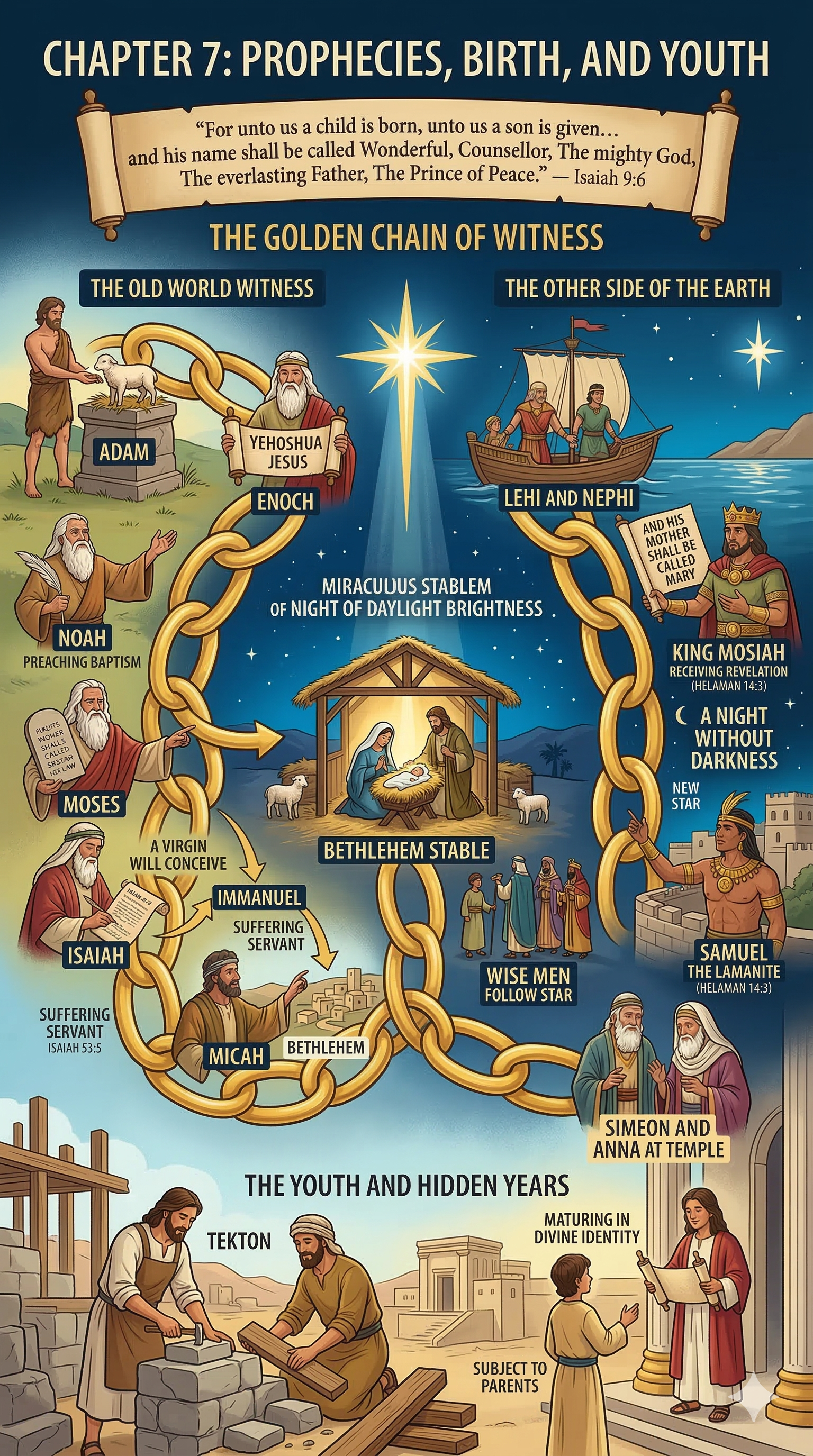
The Lord did not wait for Israel. He did not wait for Isaiah. He began with Adam—with an altar, with the blood of an animal, and with an angel's voice explaining what the offering meant. "This thing," the angel said, "is a similitude of the sacrifice of the Only Begotten of the Father, which is full of grace and truth. Wherefore, thou shalt do all that thou doest in the name of the Son" (). Adam obeyed without fully understanding, and the Holy Ghost fell upon him and bore witness: "I am the Only Begotten of the Father from the beginning, henceforth and forever, that as thou hast fallen thou mayest be redeemed, and all mankind, even as many as will" ().
Every lamb that bled on every altar from that morning forward was a living prophecy, a symbolic promise that would take thousands of years to be fulfilled. A promise that every generation of seekers and saints has sought to understand since that first sacrifice.
The chain of witness grew longer with every generation. The Prophet Enoch received the name—Jesus, Yehoshua, "Jehovah is Salvation"—long before the nation of Israel existed. Noah preached repentance and baptism in that same name centuries before Abraham walked out of Ur. Jacob, dying, said the scepter would not leave the tribe of Judah until Shiloh came—a name scholars translate as "the one to whom it belongs" (). Moses, face to face with God, was told plainly: "Mine Only Begotten is and shall be the Savior" (). And then Moses gave an entire nation a Law whose whole purpose was not to save them through their keeping of it, but to keep pointing their eyes in one direction—forward, toward the One the Law was always about.
I try to imagine what it meant to live before the coming of the Messiah—to wonder what Israel would feel when her King finally arrived. Would I have understood His true mission from the prophecies? Would I have heard His teachings and felt the Spirit fill me with recognition of the promised Messiah?
The feasts. The sacrifices. The Law. The Temple in its glory. All of it a vast, elaborate, centuries-long schoolmaster—God preparing a people, in the only language they could yet receive, reminding them that He was coming. Faithful men and women kept those feasts and said those prayers and offered those sacrifices and died without having seen the promise fulfilled. Their hunger was real. Their waiting was not passive. It was an act of faith performed across centuries, each generation passing the flame of hope and the traditions of remembrance to the next.
What Was Promised
As the centuries passed, the collected prophetic knowledge of the coming Chosen One grew in volume and detail. The prophecies were not vague spiritual impressions. They were specific. And they converged on a growing portrait of the Messiah, so He would be recognized.
Isaiah wrote that a virgin would conceive and bear a son, and that his name would be called Immanuel—God with us (). Micah named the town: not Jerusalem, not the great city, but Bethlehem—a small one, obscure even among the villages of Judah ().
His nature and mission exceeded every imagining Israel had conceived of for a deliverer: "Wonderful, Counsellor, The mighty God, The everlasting Father, The Prince of Peace" ().
Isaiah also described what His divine mission would cost Him: "He was wounded for our transgressions, he was bruised for our iniquities: the chastisement of our peace was upon him; and with his stripes we are healed" ().
That passage was written seven centuries before His sacrifice. Read it again slowly. Wounded for our transgressions. He did it for us. The prophet saw the suffering servant before the servant had been born, and described him well enough that when it happened, those who had eyes to see could recognize it.
And after the suffering— promised that God would not leave His Holy One to see corruption in the grave. He would rise. This prophecy was also written far in advance of the events.
Voices from the Other Side of the World
On the other side of the earth, separated from Israel by an ocean and six centuries of time, God was not silent.
A family had left Jerusalem around 600 BC, led by a prophet named Lehi. They crossed the wilderness, built a ship, and sailed to a land they had never seen. And in that new world, the same Spirit that moved on the waters of creation continued to speak. Lehi taught his children that "a Prophet would the Lord God raise up among the Jews—even a Messiah, or, in other words, a Savior of the world. And he also spake concerning the Prophets, how great a number had testified of these things."
Another prophet named Nephi taught that Abraham had seen the Messiah's coming and was filled with gladness, and that thousands of years before His birth, prophets had already been called according to the order of His Son (). A king named Mosiah received a revelation more than a hundred years before His birth. He prophesied: "He shall be called Jesus Christ, the Son of God, the Father of heaven and Earth, the Creator of all things from the beginning; and his mother shall be called Mary" ().
Not a title. Not a symbol. A name. A woman's name. Given a century early, to a prophet on the other side of the earth. I have never been able to read that passage casually. There is something in that specificity—his mother shall be called Mary—that lands differently for me every time. The divine promise was moving toward a particular woman in a particular village, and God named her to prophets who would never meet her.
About five years before the birth of the Messiah, a man named Samuel climbed the wall of a city filled with people who wanted him dead and told the people what to watch for (). He said there would be a night that did not go dark. The sun would set, and the darkness would not come—the night before the Savior's birth would be as bright as day. One day and one night and another day, as if there were no night between them. And a new star would appear—one no one had ever seen. He described the sign that would be seen the whole world over.
Holy Family
In the hill country of Galilee, in a town that no one of importance came from, a young woman named Mary was going about her ordinary life when the world changed.
She was not a figure of public importance. She was a girl, probably in her early teens, betrothed to a craftsman named Joseph—a man of quiet faithfulness who worked with his hands and held the legal inheritance of a royal bloodline that the Roman occupation had suppressed, along with every other reminder that Israel had once been a kingdom. As a child of a devout Jewish household, Mary had been raised to look forward with faith for the coming of God's Messiah. She was a daughter of Abraham through the tribe of Judah. She was a royal descendant of David himself, though that mattered very little in a village under occupation.
Prophets described her hundreds of years before she was born. A Book of Mormon prophet saw her in vision and called her "most beautiful and fair above all other virgins" (). Another called her "a precious and chosen vessel" (). Heaven had been watching her for a long time.
And then she was visited by the angel Gabriel (). I don't think we give enough thought to what that moment must have felt like. An angel of God, in her home, telling her she had been chosen to be the mother of the Messiah—the One all those sacrifices had pointed to, the One Enoch had named, the One Samuel had predicted with a night without darkness. The One Israel had waited for across forty generations.
The text says she was troubled. Of course she was. But then it says joy came. And then she said yes. "Behold the handmaid of the Lord; be it unto me according to thy word" ().
That sentence is one of the great acts of faith in all of scripture. She did not know what it would cost her. She did not know about Herod, or Egypt, or the sorrow that Simeon would say would pierce her own soul. She knew she had been chosen, and she accepted. Everything that follows in this chapter, and the next, and the one after that—everything comes from that moment of faithful consent.
Joseph
When word reached Joseph in Nazareth that Mary was pregnant, he had no way to understand what had happened (). In a small community where everyone knew everyone, the sting of this shocking news would have been devastating—hurt and embarrassment are the natural human response, and the scripture does not pretend it was otherwise.
But Joseph was a just and righteous man. He knew what the Law required of him—it required him to bring her before the judges of Israel, who would very likely have condemned her to being stoned to death for adultery committed during betrothal. He could not do it. He would end the engagement privately, quietly, sparing her whatever shame and harm he could.
Mercifully, God intervened. The angel Gabriel came to Joseph too (). He was told not to fear, that the child was the Son of God, that He would "be great, and shall be called the Son of the Highest: and the Lord God shall give unto him the throne of his father David" (). Joseph received this witness and accepted Mary as his wife—a woman several months pregnant, in a small town where nothing was private, at great social cost to himself.
That act deserves more than a footnote. Joseph's willingness to absorb shame he did not deserve, to protect a woman carrying a child that was not his, to step into a story bigger than himself without fully understanding it—that is a portrait of a man worth knowing. James E. Talmage wrote that had Judah been a free nation ruled by her rightful sovereign, Joseph the carpenter would have been her crowned king; and his lawful successor to the throne would have been Jesus of Nazareth, the King of the Jews. Joseph, the rightful king of Israel, was humbly building things with his hands in a Roman-occupied province. And he willingly spent his best years raising the Son of God as his own.
Both Mary and Joseph were of the royal house of David. Both were living modest lives under occupation, their inheritance unrecognized by any earthly authority. Only a few people on earth had any idea of the weight they were carrying.
Bethlehem
Near the end of Mary's pregnancy, Caesar Augustus required a census (). Every Jewish family was obligated to register in the city of their ancestral origin. For Joseph, that meant Bethlehem—Micah's town, David's town, the town the prophets had named.
We know only scattered details of their journey. The text says only that she went with Joseph, that they arrived, that there was no room at the inn. What we know is that the Son of God was born in a stable—in the company of animals, in the smell of hay and earth, with a feeding trough for His first bed. There was no midwife named in the record. No gathered family. No dignitary. Just the two of them, and then the three of them.
That little child in the borrowed trough was the great Jehovah, the Creator of the heavens and the earth. Let that sit for a moment. The Being who had spoken worlds into existence was now small enough to be held in one person's arms. The One the whole ancient world had been pointed toward had arrived—and almost no one noticed.
Except that the night was full of light that caused the nations to wonder and chosen holy men to wander.
The First Witnesses
In the fields outside Bethlehem, shepherds were keeping watch over their flocks (). They were not important men. They were not the kind of people to whom announcements were made, in any normal order of things. And then the angel came, and the glory of God shone around them, and they were terrified—a reasonable response—and the angel said: "Fear not: for, behold, I bring you good tidings of great joy, which shall be to all people. For unto you is born this day in the city of David a Saviour, which is Christ the Lord" (). And then the sky filled with more of them, a host of angels, and they were singing.
The Lord Jesus would be known as the Good Shepherd. It is no accident that the first people to worship Him were shepherds. They found the child exactly as they had been told. After worshiping, they went and told everyone they could find. Shepherds became evangelists decades before fishermen became apostles.
Forty days later, Mary and Joseph brought the infant to Jerusalem to be presented at the Temple as the Law of Moses required (). An old man named Simeon had been waiting in the Temple his whole life—the Holy Ghost had promised him he would not die before he had seen the Lord's Christ (). Day after day, year after year, he had come to the Temple.
On that day, Simeon saw them come in and the Spirit moved him to take the baby into his arms and say: "Lord, now lettest thou thy servant depart in peace, according to thy word: for mine eyes have seen thy salvation, which thou hast prepared before the face of all people; a light to lighten the Gentiles, and the glory of thy people Israel" ().
A prophetess named Anna was also there that day—eighty-four years old, who had been fasting and praying in the Temple for decades (). Being in the Spirit, she recognized the child as the promised Messiah. She told everyone who would listen that the redemption of Israel had arrived.
Outside, a star was burning that the world had never seen. Wise men from the east had seen it rise and followed it (). They came bearing gifts for a king—gold, frankincense, and myrrh—and they found the King of Kings in the last place earthly wisdom would have looked.
Herod and Egypt
King Herod heard about the wise men's errand and understood what it meant (). A prophesied king of the Jews was a threat to his throne. He ordered the massacre of every male child under two years of age in Bethlehem. Joseph was warned in a dream and fled before the soldiers came, taking his family south through the Nile delta into Egypt. They lived there as refugees for several years, until Herod died and it was safe to return.
The Son of God spent His early childhood in exile. He would have been a brown-skinned child of refugee parents, speaking Aramaic in a foreign country, entirely dependent on the faithfulness of two young people who understood only in part what they were carrying.
God the Father was watching all of it. Of His Son, the ancient scripture promised: "He shall give his angels charge concerning thee: and in their hands they shall bear thee up" (). That protection was real. It was also exercised through the courage and obedience of ordinary people—a man who listened to dreams, a woman who said yes in the dark.
Nazareth and the Years of Formation
When Herod died, the family returned—not to Bethlehem, but to Nazareth, the town in Galilee where Joseph and Mary had lived. Joseph resumed his work as a tekton—a craftsman in stone and wood, the kind of builder a growing region needed. The family settled into the rhythms of Galilean village life, and Jesus grew up inside them.
Nazareth in the first century was a small agricultural village—just a few hundred people, everyone knowing everyone else's business. It was not a prosperous place, and it was not an important one. When Philip later told Nathanael that the Messiah had come from Nazareth, Nathanael said what anyone would have said: "Can any good thing come out of Nazareth?" The question was not malicious. It was just geography.
The Jewish world Jesus grew up in was saturated with the things of God in a way that is difficult for modern secular readers to fully imagine. The washing of hands before meals, the dietary laws of kashrut, the weekly Sabbath rest—these were not burdens for a devout family. They were the texture of daily life. From his earliest years, Mary had been teaching her son the Shema—"Hear, O Israel: The Lord our God is one Lord"—the first prayer of the morning, the last prayer of the night, the covenant declaration at the center of Israel's identity.
At five, Jesus would have begun formal study at the synagogue school. The content was Scripture—Torah, Prophets, Psalms—read, copied, and memorized until it became part of the student's inner life. The evidence of the Gospels suggests Jesus went well beyond the village average.
He was not a monolingual villager. His mother tongue was Galilean Aramaic—the language of his home, his friendships, his prayers with his family, most of his later teaching. His name in that tongue is "Yeshua." Hebrew was the sacred language of the synagogue, where he would have been called the more formal "Yehoshua," and he was literate in it—Luke records him reading publicly from the Isaiah scroll. Greek, the trade language of the region, was almost certainly part of his working life as he grew older.
Three times each year—at Passover, Pentecost, and Tabernacles—observant Jews were commanded to present themselves before God at the Temple in Jerusalem (). Luke tells us the family made the Passover journey every year (). These were not casual trips. They were caravan journeys—extended family, neighbors, the whole village moving together, days of walking and sleeping outdoors, arriving at Jerusalem with thousands of pilgrims from across the Jewish world, the city swelling beyond its walls. The Temple itself: its courts, its sacrifices, the smoke of the offerings, the sound of the shofar at the great festivals. These were the defining experiences of Jewish childhood.
Jesus absorbed all of it. Every word of Torah he memorized, every sacrifice he watched, every Sabbath his family kept, every Passover he celebrated—all of it was shaping the One who would one day say "I am the resurrection and the life" and mean it literally.
He also worked. Jewish tradition was explicit on this point: a father was obligated to teach his son a trade. The saying ran that a man who failed to do so was teaching his son to steal. Alongside Joseph, Jesus cut stone and shaped wood in a region where limestone was plentiful and timber was not. When Herod Antipas began rebuilding the city of Sepphoris four miles away—a major construction project that went on for years—Jesus almost certainly worked those sites with Joseph. He would have hauled rock and shaped timber. He would have watched wealthy patrons negotiate contracts. He would have seen day laborers gather in the market square, anxious for work. He would have seen what happened to the ones who were not chosen by day's end.
The parables he would later tell were not invented illustrations. They were memories.
At twelve, Jesus was approaching the threshold of bar mitzvah—the age at which a Jewish boy was considered old enough to begin assuming adult religious responsibilities. Luke records a Passover journey to Jerusalem that year, and what happened when the family turned for home: Jesus stayed behind, and they did not discover this for a full day of travel (). When they came back and found him, he was in the Temple courts—sitting among the teachers, listening to them, asking questions. And the text says everyone who heard him was astonished at his understanding and his answers.
His mother said what any mother would say after three days of searching: "Son, why hast thou thus dealt with us? behold, thy father and I have sought thee sorrowing" ().
He looked at her and said, with the calm directness that would characterize him for the rest of his life: "Wist ye not that I must be about my Father's business?" () His awareness of his divine identity was not something he broadcast. It was something he carried quietly, maturing in him, showing itself in moments like this one—and then, apparently, he went home to Nazareth and was subject to his parents for another eighteen years, and the Gospels say nothing more about it.
"And Jesus increased in wisdom and stature, and in favour with God and man" ().
The Hidden Years
For eighteen years after that moment in the Temple courts, we have no record. The Gospels are silent. Historical sources are silent.
I want to say something about that silence, because I think we sometimes treat it as a gap—an unfortunate absence of information we wish we had. But I think the silence is the point. Jesus was not a wandering mystic during those years. He was not performing quiet miracles or gathering secret disciples. There is no evidence of that. The silence in the record is consistent with a man living an ordinary life: working his trade, caring for his family, observing the Law, attending the synagogue, going to the Temple for Passover. Being a neighbor. Being a son.
Part of the life He lived was to see His holy family lose father Joseph. Joseph disappears from the Gospel record entirely after the Temple episode—no mention of him at the wedding in Cana, no mention of him during the ministry, and Jesus' act of committing his mother's care to John from the cross makes no sense if Joseph were still living. Before his public ministry began, Jesus would have assumed responsibility for his mother and his younger siblings—the provider and head of a household, carrying an ordinary man's ordinary weight.
That is not nothing. It is, in fact, the whole point of the hidden years.
The Jesus who walks to the Jordan River to be baptized by John at the age of thirty is not a figure arriving from somewhere else. He is the product of those thirty years—formed by the family that raised him, the Scripture that saturated him, the labor that calloused his hands, the grief that came with losing Joseph, the prayers said morning and evening his whole life. He knows what it is to be tired. He knows what it is to work hard for pay. He knows what it costs to bury someone you love. He knows the smell of a synagogue, the sound of the Passover seder, the feel of Jerusalem under his feet after days of walking.
He is ready. Not because thirty years were required to complete him—he was always the Messiah. But the preparation was the point. His humanity was real. When he says "I know your sorrows"—he knows them from the inside.
In the year that John the Baptist stood in the Jordan and called all of Israel to repentance—to turn back, to make straight what had been crooked, because the Kingdom of God was at hand—a man from Nazareth came down from Galilee and waded into the water. He had been a craftsman's apprentice, a carpenter, a son, a neighbor. And he was about to become everything the ancient world had been waiting for since the first lamb bled on Adam's altar.
We testify that the Star of Bethlehem shed its light for His birth. Wise men from surrounding countries, shepherds in the field, generations of prophets, and even kings and choirs of angels recognized the time of His birth. It was not a surprise. It was not a folktale. Yeshua of Nazareth, Yehoshua the Son of God in the Highest, was born to save us from sin and death.
In the name of Jesus Christ, amen.