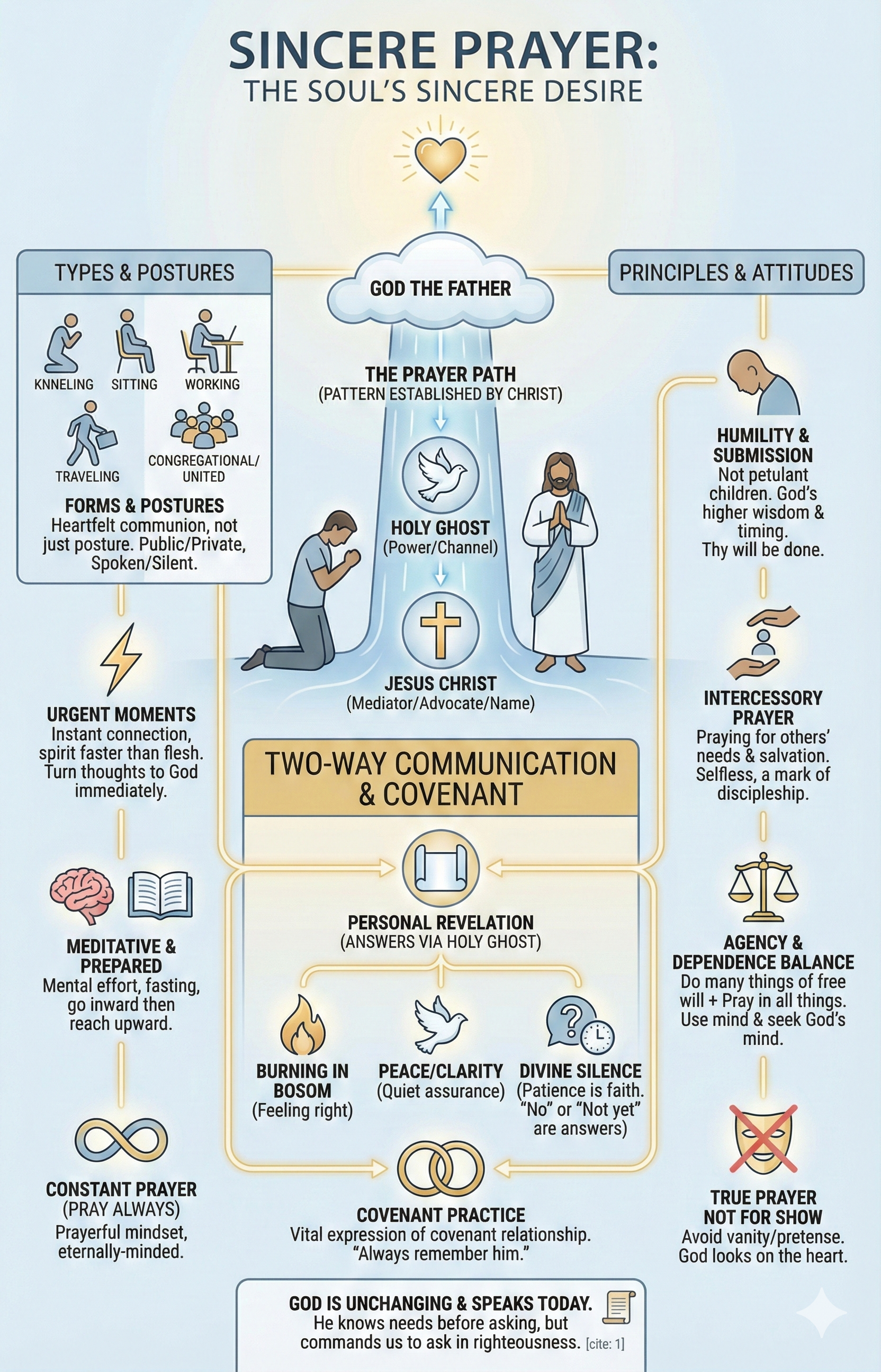
The Soul's Sincere Desire
Prayer is an important way to exercise one's spirituality. More than this, prayer is a commandment of God (1 Thessalonians 5:17). During His mortal life, Christ frequently prayed in public and in private, setting the example we should follow. The resurrected Lord commanded, "Pray in your families unto the Father, always in my name, that your wives and your children may be blessed" (3 Nephi 18:21).
So what is prayer? How do we know when we are doing it right? James Montgomery wrote an insightful poem about prayer that has been turned into a beautiful hymn. In it he expresses a simple and poignant truth: "Prayer is the soul's sincere desire" (James Montgomery, "Prayer Is the Soul's Sincere Desire," Hymns, no. 145). Truly, the essence of prayer is desire. There are prayers of praise, thanksgiving, supplication, and confession. Prayer can even come out of the simple need to feel reassured by the love and power of God. All sincere prayers, great and small, come from the longings of the soul. The Lord Jesus Christ taught us the pattern for prayer. His example is known as the Lord's Prayer:
Our Father who art in heaven, Hallowed be thy name. Thy kingdom come. Thy will be done on Earth, as it is done in heaven. Give us this day, our daily bread. And forgive us our trespasses, as we forgive those who trespass against us. And suffer us not to be led into temptation, but deliver us from evil. For thine is the kingdom, and the power, and the glory, forever and ever, Amen. (JST Matthew 6:9-15)
The Lord did not intend for us to repeat memorized prayers. He said plainly, "When ye pray, use not vain repetitions, as the heathen do: for they think that they shall be heard for their much speaking" (Matthew 6:7). More than this, there is no need for sophisticated language, for "the Lord looketh on the heart" (1 Samuel 16:7). Speak what is in your mind and heart. And speak truthfully, for there can be no deception before God. The words used in prayer change and the circumstances vary from day to day, but prayers often include the following elements, though not necessarily in this order.
A Pattern for Meaningful Prayer
- Speak directly to God, and address Him respectfully (e.g., Father in Heaven).
- Express gratitude for blessings while in a mindset of worship.
- Share your burdens, for He is a Counselor and a Comforter.
- Ask for forgiveness from our sins, and for help to forgive others of their sins against us.
- Plead for desired knowledge and blessings in an attitude of humility and patience.
- Pray for others—for their needs, their struggles, and their salvation.
- Pray all things in the name of Jesus Christ (Colossians 3:17).
- Conclude with the word "Amen," which Christians adopted from the ancient Hebrew אָמֵן ('āmēn), meaning "truth" or "certainty," used as a sincere expression of belief in what has been said.
Latter-day Saints direct their prayers to God the Father, in the name of His Son, Jesus Christ. This is not merely tradition; it is the pattern the Savior Himself established. When the disciples asked Him how to pray, He taught them to begin, "Our Father who art in heaven" (JST Matthew 6:9). Christ is our Mediator and Advocate with the Father (D&C 45:3), and it is through His name and His atoning sacrifice that we are granted access to the Father's presence in prayer. We pray to the Father, through the Son, by the power of the Holy Ghost.
Forms and Postures of Prayer
Prayer can take many forms. It may be a group effort of an entire congregation of believers. It can be spoken out loud in family, or alone as a personal prayer. It can take place while kneeling, standing, sitting, lying down, working, traveling, and so on. It can even take the form of private thoughts directed to God. No matter the case, the focus of prayer should be on heartfelt and intimate communion with God.
While much of this chapter focuses on personal and family prayer, we should not overlook the power of united prayer among the Saints. Jesus promised, "Where two or three are gathered together in my name, there am I in the midst of them" (Matthew 18:20). The early Church practiced communal prayer with great effect (Acts 4:31). In our day, congregational prayers, group fasts, and the practice of placing names on a prayer list reflect the same principle: there is power when the faith of a community is united in petition before God. The prayers of a congregation can bear up an individual in ways that his or her own prayers alone cannot. This is one of the blessings of belonging to the body of Christ.
True Prayer Is Not for Show
True prayer—the soul's sincere desire—is not for show. It displeases God when we try to give the public appearance of righteousness or an open pretense of spiritual piety (Matthew 6:5-6). Prayer is not a matter of vanity, pride, or competition; yet one can stand no taller in this life than while on bended knees in humble prayer before the Lord.
Preparing for Meaningful Prayer
When we choose to pause and pray, it is important to mentally and physically prepare ourselves beforehand. It is ideal to take time to spiritually meditate and pray over ideas, choices, and responses to the needs of others. Whether we come to prayer composed or desperate, the essential act is the same–we must go inward and then reach upward. Find the innermost part of who we are, and from that place reach out with sincere desire to connect with God the Father.
Enabled by such preparation, there have been disciples described in the scriptures as praying mightily unto God. Such prayer requires real mental effort and the exercising of faith. In addition to spiritual preparation, faithful disciples in all ages have often coupled fasting with prayer. Fasting is a sign of devotion and serves to strengthen our spirits over physical appetites, enhancing our sensitivity to spiritual impressions (Alma 17:3).
Prayer in Urgent Moments
Under urgent or stressful conditions, we can still pray effectively for help and guidance. These conditions might be dangerous situations, moments of confrontation with others, or even unexpected opportunities to do something good in the world. Under such conditions our thoughts should instantly turn to God in the very moment of dealing with the situation. The spirit is much faster than the flesh. If you carefully develop spirituality prior to an emergency, when you do cast your thoughts and feelings to God in the very moment of need, your mind makes an instant and profound connection with Him. In response, the spirit and power of God will instantly well up in your soul to inspire your thoughts, words, and actions to bring about the greatest good.
Constant Prayer
When not formally and actively praying, we should still maintain a prayerful mindset. We can come to be eternally-minded and learn to nurture a continual prayer in our hearts. We must remember the Lord's command to "pray always."
In all three types of prayer—meditative, urgent, and constant—the most powerful prayers are those in which our intent and words flow from the inspiration of the Spirit of God within us. When we are sensitive to the promptings of the Holy Spirit, our prayers and desires can align with God's will. As the Apostle Paul taught, "The Spirit itself maketh intercession for us" (Romans 8:26). When we do these things, the invitation of the Lord is in effect: "Ask, and it shall be given you; seek, and ye shall find; knock, and it shall be opened unto you" (Matthew 7:7).
Praying for Others
One of the marks of maturing discipleship is learning to pray not only for ourselves but for others. This is intercessory prayer—the practice of bringing the needs, struggles, and salvation of others before God. The scriptures are rich with examples of this selfless form of prayer. Enos began by praying for himself, but as the Spirit filled him, his heart reached outward—first to his own people, and then even to his enemies (Enos 1:9-11). Alma the elder prayed with such faith for his wayward son that an angel was sent to intervene (Mosiah 27:14). The Savior Himself, in the most intimate intercessory prayer recorded in scripture, prayed not for Himself alone but for His disciples and for all who would believe on their words (John 17:9, 20).
As our hearts grow in charity, our prayers naturally expand beyond our own concerns to embrace the needs of those around us—our families, our neighbors, those who suffer, those who serve, and even those who have wronged us. The Savior commanded, "Pray for them which despitefully use you" (Matthew 5:44). Intercessory prayer is both a sign of spiritual growth and a means by which God accomplishes His work through the faith of His children.
When Prayers Seem Unanswered
It is important to understand that unrighteous, uninspired, or selfish prayers do not bring the blessings we seek. The Apostle James taught this principle in these words: "Ye ask, and receive not, because ye ask amiss, that ye may consume it upon your lusts" (James 4:3). We must avoid false and vain prayer. The scriptures teach us to pray constantly, sincerely, and wisely (1 Thessalonians 5:17; Colossians 4:12).
But what of the righteous prayer that seems to go unanswered? The parent who pleads for a sick child. The faithful believer who prays for years over a wayward loved one. The humble seeker who kneels and hears only silence. These experiences are real, and they can be deeply painful. We must be honest about this: not every sincere prayer receives an immediate or recognizable answer, and this is not evidence that God has rejected the one who prays.
Sometimes God's answer is "no" or "not yet." Sometimes His answer is "I have something better in mind." And sometimes He asks us to continue in faith without explanation, trusting that He sees what we cannot. The Savior Himself, while in agony, prayed to the Father, "If it be possible, let this cup pass from me: nevertheless not as I will, but as thou wilt" (Matthew 26:39). The Father did not take away his suffering. Yet the Father heard Him, and an angel was sent to strengthen Him (Luke 22:43). Divine silence is not divine absence. God may not always remove our burdens, but He is always present in them. The patience to wait upon the Lord in seasons of silence is itself a form of faith, and it is precious to God.
We testify that our Heavenly Father is mindful of us and always listens to our prayers. He already knows our needs before we ask. Jesus explained, "Your Father knoweth what things ye have need of, before ye ask him" (Matthew 6:8). However, many blessings seem to be dependent on asking for them in righteousness (supplication). Further, unless we ask Him, we cannot know for sure whether important ideas are true in the ultimate sense or that a choice we are making is in agreement with His will and wisdom.
Balancing Agency and Divine Dependence
Again, prayer is a commandment of God. Though we might not always receive revelation on every detail of our lives, the Lord commanded us clearly, "Pray always" (Luke 21:36). Scriptural proverbs teach us: "Trust in the Lord with all thine heart; and lean not unto thine own understanding. In all thy ways acknowledge him, and he shall direct thy paths" (Proverbs 3:5). We are also instructed: "Be not wise in thine own eyes" (Proverbs 3:7). The Lord clarified this, saying, "Ye are commanded in all things to ask of God... and that which the Spirit testifies unto you... ye should do in all holiness of heart... doing all things with prayer and thanksgiving" (Doctrine and Covenants 46:7). Those who obey this commandment are promised that the "inspiration of the Almighty [will] give them understanding" (Job 32:8).
Pray always? Pray about everything? This commandment may seem impractical to some who value self-reliance and fear excessive dependence on others. Humans need freedom and a healthy measure of independence to grow, develop, and thrive. But this reasoning does not hold true when the "other" person is God. A wise balance must be maintained between using our God-given minds and seeking to know the mind of God.
While it is wise to exercise our minds in the search for truth and in meeting the challenges of life, it is reckless to stubbornly refuse to ask for God's help in these endeavors. It is equally unwise to refuse to make choices or take action until God commands us to do so. It is truly foolish to obtain an answer to prayers and then disregard it. Regarding all these cases the Lord revealed His wisdom, explaining, "It is not meet that I should command in all things; for he that is compelled in all things, the same is a slothful and not a wise servant; wherefore he receiveth no reward. Verily I say, men should be anxiously engaged in a good cause, and do many things of their own free will, and bring to pass much righteousness; for the power is in them, wherein they are agents unto themselves. And inasmuch as men do good they shall in nowise lose their reward. But he that doeth not anything until he is commanded, and receiveth a commandment with a doubtful heart, and keepeth it with slothfulness, the same is damned" (Doctrine and Covenants 58:26-29).
Can one keep commandments of God and still be damned? Searching for answers to this question in the scriptures, one finds that the Pharisees, scribes, and Sadducees at the time of Christ were among the most scrupulous in keeping the commandments and laws of Judaism, yet they drew many of Christ's most vehement rebukes for hypocrisy (see Matthew 23; Luke 11; Mark 12; Luke 20). As the embodiment of perfect justice, Christ's judgment in these matters was without flaw. Doing good is not enough for the Lord. He wants us to be good. Prayer is an important part of becoming good. As we grow in spirituality, we can learn to be eternally-minded and to pray continually.
We ought to weigh every thought, measure every choice, craft every communication, and perform every deed prayerfully so that we might be inspired in all these things; especially when we do not have time to evaluate and consider our actions beforehand.
Humility and Submission Before God
It is a matter of personal character development to sincerely humble one's self and praise another more-deserving soul (especially God), submitting to higher wisdom. We are completely dependent upon God's justice, mercy, and grace (see Mosiah 2:21). We must not be petulant children, expecting our Father in Heaven to bend to our will at every turn. To do so would be irresponsible parenting on His part. Rather, our prayers ought to be the humble petitions of a submissive child to a righteous Father. It is God's right to choose which blessings to bestow, when it is right to give them, and how to go about it. Like any loving parent with growing children, He holds our best interests in His almighty heart. He makes His choices out of wisdom far greater than our own. God knows what will bring about righteousness and what would bring sorrow.
Grace After All We Can Do
When we plead for a blessing, we must also remember an important principle taught by the Prophet Nephi: "We know that it is by grace that we are saved, after all we can do" (2 Nephi 25:23). This readily applies to prayer. We must be willing to do all in our power to bring about righteousness, while praying for heaven's help. We cannot sit idly, expecting blessings to fall upon us without any effort of our own.
The relationship between grace and faithful obedience is explored more fully in the next chapter. For now, it is enough to understand that this principle applies directly to prayer.
Many unbelievers say that we only bring about our desires by our own strength. Those who practice sincere and faithful prayer know that God takes an active role in guiding us to goodness, inspiring the direction of our labor, strengthening our efforts with the powers of heaven, and blessing us in such ways that all things eventually work together for our good (D&C 90:24). Trust in God and pray with patient faith, believing that the blessings will come according to God's own will and on God's own terms.
Prayer as Two-Way Communication
Prayer is not only the raising of our voices to God. It can become two-way communication. We can learn to receive answers to our questions, recognize inspiration in our daily lives, and to perceive the will of God. A common theme throughout our writings is this principle of personal revelation. Receiving answers to our prayers is personal revelation, no matter what form those divine answers take. We witness that God is willing to help all seekers find truth and wisdom. As the Psalmist wrote, "The Lord is nigh unto all them that call upon him, to all that call upon him in truth" (Psalm 145:18). More than this, as we take questions and concerns to prayer, the power of God's spirit can confirm correct ideas to our souls with such depth that it is as much a physical recognition as it is a spiritual acceptance of a truth. In this way, eternal truths become a vital part of who we are and what we will become.
The means by which God communicates with us is the Holy Ghost. As discussed in the previous chapter on spiritual knowledge, the Holy Ghost is the channel through which divine truth is confirmed to the human soul. Prayer opens the channel; the Holy Ghost carries the message. Understanding this connection is vital, for it means that the same spiritual faculties we develop in seeking knowledge of truth are the very faculties we exercise in prayer. Learning to recognize the voice of God's Spirit and learning to call out with our own spirit to pray with power are not separate skills—they are one discipline, practiced from two directions.
The Prophet Moroni said to those who search for the truth, "I would exhort you that ye would ask God, the Eternal Father, in the name of Christ, if these things are not true; and if ye shall ask with a sincere heart, with real intent, having faith in Christ, he will manifest the truth of it unto you, by the power of the Holy Ghost. And by the power of the Holy Ghost ye may know the truth of all things" (Moroni 10:4-5). The Apostle James also taught the principle of personal revelation of truth. He wrote, "If any of you lack wisdom, let him ask of God, that giveth to all men liberally, and upbraideth not; and it shall be given him" (James 1:5-6).
The Lord revealed to a modern Prophet instructions on the subject of obtaining clear answers to prayer: "Behold, you have not understood; you have supposed that I would give [the answer] unto you, when you took no thought save it was to ask me. But, behold, I say unto you, that you must study it out in your mind; then you must ask me if [your choice] be right, and if it is right I will cause that your bosom shall burn within you; therefore, you shall feel that it is right. But if it be not right you shall have no such feelings, but you shall have a stupor of thought" (D&C 9:7-9).
A word of pastoral counsel regarding this passage: the Lord's description of a "burning in the bosom" has led some to expect a single, dramatic physical sensation as the sole form of divine confirmation. In practice, the Spirit speaks to different souls in different ways. For some, the confirmation comes as a warm feeling of peace and assurance. For others, it is a quiet clarity of mind, an unmistakable sense that a thing is right, or simply the absence of confusion where confusion had been. The Lord said He would speak "in your mind and in your heart" (D&C 8:2)—both intellect and feeling are involved, and the balance between them may differ from person to person and from question to question. Do not dismiss a genuine answer from God because it arrives differently or more quietly than you expected. Learn to recognize His voice in whatever form it takes.
After we pray, we should pause and meditate upon our thoughts and feelings. How can we hear God's voice if we do not listen?
Prayer as a Covenant Practice
For those who have entered into covenants with God through baptism and temple ordinances, prayer takes on an added dimension. It is not merely a devotional habit or a technique for receiving answers. Prayer is a covenant practice—a vital expression of the ongoing relationship between a disciple and the God to whom he or she has made binding promises. When we covenant with God, we promise to "always remember him" (D&C 20:77). Prayer is the most direct way we fulfill that promise each day. In return, He promises that we may "always have his Spirit" to be with us. The covenant and the prayer are inseparable: to cease praying is, in a very real sense, to turn away from the covenant itself.
God's Unchanging Nature
As do many other Christians, Latter-day Saints believe that God is the same yesterday, today, and forever (Hebrews 13:8; Mormon 9:9; Moroni 10:7, 19; D&C 20:11-12). In spite of this common belief, many scoff or recoil at the thought of prayer leading to personal revelation from God in this modern day and age. God said of Himself, "I am the Lord, I change not" (Malachi 3:6).
Through personal revelation, God has spoken to Prophets and righteous men and women in the past in ways both great and small. This has not changed. If His work was finished in the days of Adam, He would not have revealed His will to the rest of the great patriarchs. If God's work was finished in the days of Abraham, Isaac, and Jacob, He would not have revealed His will to Moses. If His work was finished in the days of Moses, He would not have revealed His will to later Prophets of Israel. If His work was finished upon the completion of the collected books of the Old Testament, Christ would not have come in the flesh. If God's work was finished upon the perfection of Christ's sacrifice, He would not have revealed His will to the Apostles following Christ's death and resurrection. God's work is never finished. He yet speaks to those who both ask and listen. He is the same yesterday, today, and forever.
The ninth article of faith of The Church of Jesus Christ of Latter-day Saints states, "We believe all that God has revealed, all that He does now reveal, and we believe that He will yet reveal many great and important things pertaining to the Kingdom of God." Prayer leads to personal revelation: when we pray right, when we pray always, when we pray for the right reasons, and when we listen to God's answers.
A Witness of the Power of Prayer
We testify with all our strength of the power of prayer. God knows our needs and listens as we pray to Him. We all desperately need the strength of a personal relationship with God that only prayer can provide. Reach out to God with your heart and mind. Pray with a sincere heart to know Him and to know truth. He will answer. We promise this to you in the name of Jesus Christ. Amen.