The Human Condition
We are all so very human. Our wandering feet carry us along many curious and often frightening paths. Our untamed hearts pull or push us in unexpected directions. Our wide eyes marvel at the fleeting scenes of beauty and filth which unfold around us. Our grasping hands shape the environments and cultures we touch. Our unceasing voices speak much, yet too often say little. Our twitching ears are filled with the discordant noises of life. Our restless minds wrestle with the meaning of it all, desperate to forget the bitter and remember the sweet. Yet humanity occasionally manages to find itself, to gentle itself—to see, free, quiet, harmonize, and understand itself.
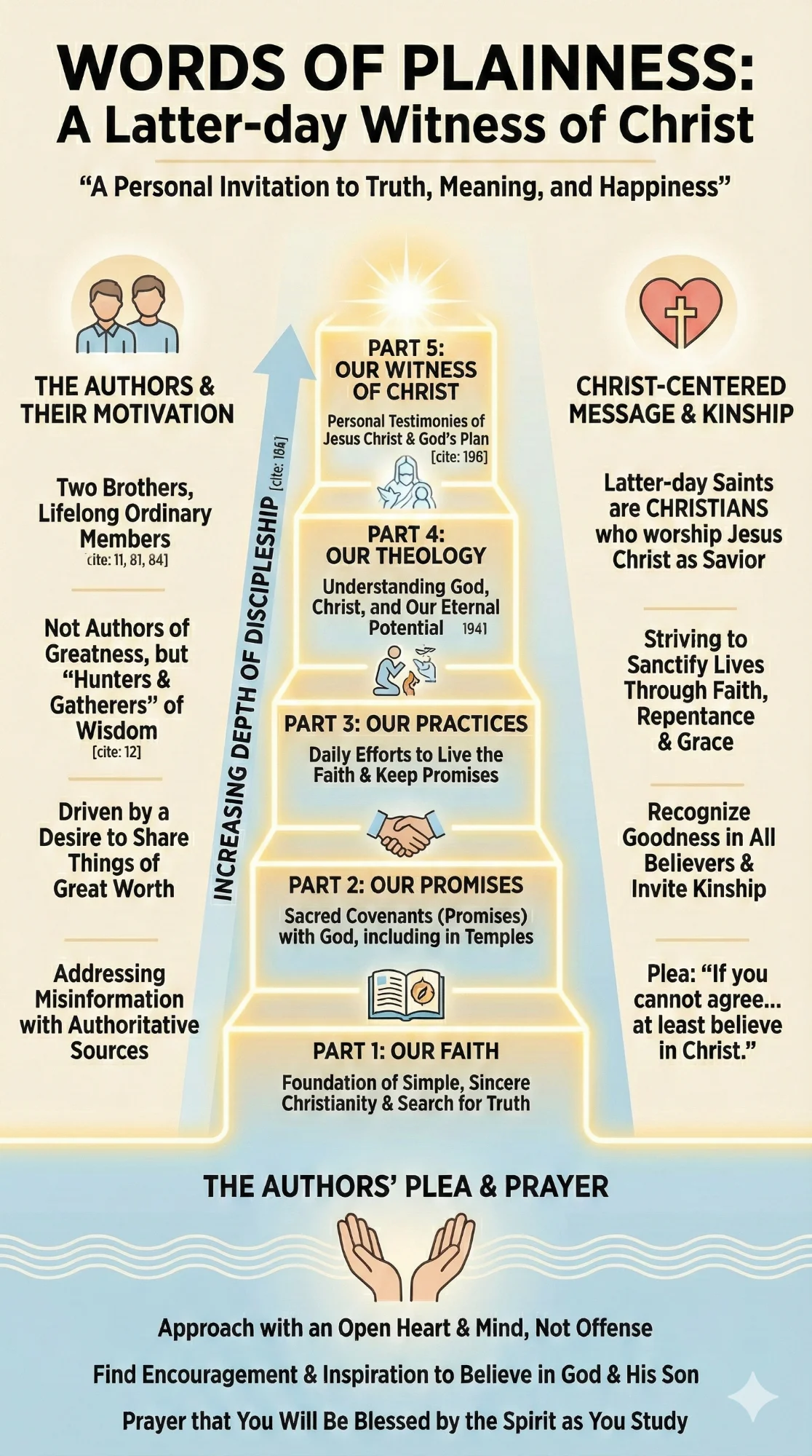
The writers of this book are brothers. We use the word writers because we feel that we are not the authors of any particular words of greatness. Instead, we are hunters and gatherers of knowledge. We till and seed the soils of our souls hoping to harvest wisdom.
We are native citizens of the world, yet we perceive the foreign nature of mankind's walk upon the Earth. Though our journey is not complete, my brother and I have found ourselves both on the side of right and clearly in the wrong often enough to have gained an abiding appreciation for the many profound lessons that can be gleaned from the human experience.
Origin of Our Writings
As a young man I, Aaron, chose to serve a mission to the people of Argentina for The Church of Jesus Christ of Latter-day Saints. In my idealism, I hoped to bring light and goodness to people who had been less fortunate. I like to believe that I left something of value behind for the people I came to love, but I returned deeply transformed by my experiences.
The new thoughts I learned to think and the tender feelings I came to cherish during my mission planted in my heart a seed of passion for sharing things of worth with others. I returned to a world that is far more complex and fast-paced than my mission experience had been, and I found it somehow the lesser for it. In spite of this, that latent kernel of desire swelled in my heart and grew. I began searching for ideas, experiences, and things of great worth. I wrote of them. I did not know to whom I was writing. I had not considered my audience.
After some time, I suspected that I might be crafting letters to my unborn children. I came to believe that my collection of writings could become a simple legacy that I might leave behind at my journey's end. I became convinced that stories of my life, my tempering experiences, and meaningful traditions, along with my humble understandings, precious beliefs, and faith-filled encouragement are the only meaningful inheritance I can bequeath to my posterity.
When my adventures with family and children began, my yearning to gather and then write of these things became a driving need. In my late thirties, I felt a strong urge to better organize my hard-learned lessons and happy discoveries in the form of a book or collection of letters. I am not finished learning, but I felt my experience and understanding was sufficient to truly begin sharing. Spending a few hours each night, as I could spare, I finished my first rough draft in a little more than six months.
I shared my collected works with my older brother, Jim. He has long been more than an example of manhood to me; he is a trusted friend. His comments, questions, suggestions, and assistance became such an important part of editing my letters that I realized they are as much the result of his life experiences as they are of my own.
Our long studies and preparations seemed to take on a life of their own. We quickly adopted the belief that such beautiful ideas and experiences must be shared in words of plainness. This philosophy became the title of our work. We understand that the publication of such personal things may open us to criticism and unforeseen consequences. We have long considered and earnestly prayed about our decision to act in accordance with our desires. We offer our Words of Plainness to you with hope, for they are the treasured things of our souls.
Timeliness of Our Words
The topics of our writings seem appropriate for the times in which we find ourselves. The Church of Jesus Christ of Latter-day Saints and its members have become the subject of a surprising amount of media coverage, both favorable and not. Debate over the Church's history, beliefs, and practices appears in popular tabloids, newspapers, books, television programs, online forums, and even in widely public political arenas.
An enormous volume of misinformation and malicious propaganda exists about the restored gospel of Jesus Christ and members of the Church. During our long years as public school teachers, we struggled to convince students of the vital importance of using authoritative sources of information when doing research and in the formation of lasting opinions. Gossip columns, hate blogs, and literature critical of the Church are tantalizing reads, but they seldom offer much in the way of actual credibility. Tracing the citations and sources of such information, one finds little more than hearsay and quotations either taken out of context or hastily borrowed from other unverifiable sources. Though false information might be presented energetically and even well-received by many, it remains fundamentally untrue.
Throughout history, it has been consistently true that the odd combination of ignorance and confidence eventually leads to suffering, oppression, bigotry, and hatred. We believe that it is essential to the character of each human being to search for truth, meaning, and lasting happiness—and that we must do so while upholding the virtues of honesty, compassion, and tolerance. Surely these are the noblest of emerging characteristics possessed by enlightened individuals and found within civilized cultures.
Learning from Authoritative Sources
With regards to faith and religion, it seems like common sense that if you want to know what a Baptist believes you should ask a Baptist. If you want to know what a Methodist believes you should ask a Methodist. This is also true for Roman Catholics, Buddhists, Hindus, Muslims, and so on. It is equally true that not all Baptists believe the same body of doctrines or behave the same way. Likewise are the Methodists, Catholics, Buddhists, Hindus, Muslims, and so forth.
On a related note, the term "Mormon," though once commonly used as a shorthand, is technically inaccurate and increasingly discouraged when referring to The Church of Jesus Christ of Latter-day Saints, its doctrine, history, or its members. This is because it obscures the Church's Christ-centered identity and reduces a complex faith to a nickname derived from the Book of Mormon rather than from Jesus Christ, whom Latter-day Saints worship as the Son of God. The name "Mormon" originated as an external label and later became culturally widespread, but it does not appear in the Church's formal name and can unintentionally imply that members follow a figure named Mormon rather than Christ. In recent years, Church leaders have emphasized using the full name of the Church or the term "Latter-day Saints" to reflect theological accuracy, historical continuity, and respect for religious self-identification. Using precise language not only honors the beliefs of its members but also avoids reinforcing misunderstandings about their faith, practices, and relationship to broader Christianity.
Our Credentials as Latter-day Saints
My brother and I have spent our lives within the culture and practices of the faith of The Church of Jesus Christ of Latter-day Saints. We vehemently oppose any who are audacious enough to pretend to know more about our own personal views than we do. We claim the right to be the supreme mortal authorities over what we personally believe, how this makes us feel, and how we interpret the effects of living as Latter-day Saints within our own life experiences.
We are active members of The Church of Jesus Christ of Latter-day Saints, yet we feel the need to offer some few credentials which establish our general worthiness to represent regular, ordinary, everyday members of our Church and that we live a reasonably common Latter-day Saint lifestyle.
Our Conversion and Upbringing
We were born to Lutheran parents. Our mother investigated and eventually chose to convert to The Church of Jesus Christ of Latter-day Saints. Many friends and relatives questioned or even opposed her decision. She was baptized while she was pregnant with Aaron, the younger of the two writer brothers. James also later converted. Our childhoods were strongly enmeshed in the culture and society of Church members. We actively and regularly attended worship services and participated in the Church's Primary and youth programs.
Priesthood and Service
We were both formally ordained to the "Lesser" Priesthood in our adolescence. We were successively set apart in the offices of Deacon, Teacher, and Priest. We feel that we faithfully officiated in these offices by preparing and passing the emblems of the Lord's Supper, collecting fast offerings for the poor, home teaching our fellow members, baptizing those who came into the Church, and assisting in assorted temporal responsibilities.
As young adults we were both ordained to the "Higher" Priesthood. We were both set apart as Elders and performed as such. We were both called and set apart to full-time proselyting missionary service. We both received our temple endowments, whereby we made sacred covenants (promises) with God in His holy temple.
We have been married to our wives in the temple and sealed to them for time and all eternity. We have raised (and are raising) children who have been sealed to us for eternity in the temple. We have been called and set apart in many positions of service throughout our lives in the Church. Currently, James is serving as a High Priest in his ward. Aaron is serving as an Elder in his ward. We anticipate, God willing, a lifetime of service to our fellow members and to all God's children.
Our Lives as Latter-day Saints
We pay our tithes and offerings. We worship in our ward congregations every Sunday. We attend and officiate in temple worship. We fast and we pray. We read and study the Scriptures. We are not perfect, but we continually repent and seek to align our lives with God's will. We strive to cultivate the fruits of the Spirit: patience, kindness, love, charity, peace, joy, meekness, etc. We seek to obtain the gifts of the Spirit described in 1 Corinthians 12: wisdom, faith, healing, miracles, prophecy, discerning of spirits, speaking in tongues, and interpretation of tongues. We study with open hearts and minds.
We seek to be of service to our fellowman. We seek to be forgiving, slow to anger, and to avoid unrighteous behaviors. We seek to be good neighbors. We seek to be good friends and good examples, even if no one is watching. We seek to be humble and teachable. We seek to be genuine disciples of Jesus Christ. We bear public witness that Jesus Christ lives, that He loves us, that He has made it possible for us to be forgiven of our sins, and that all are invited to come unto Him and be sanctified of their sins and made righteous if they will but have faith in Him, repent, be baptized, and follow Him to the end of their mortal journey.
Christ-Centered Faith
Our witness of Jesus Christ is the most important aspect of Words of Plainness. Many who are unfamiliar with the teachings of The Church of Jesus Christ of Latter-day Saints question or even deny our status as a Christian faith. We do not question or deny anyone else's status as Christians. Regardless of the opinions of critics, members of our Church are Christians. We are of the same Spirit as other Christians, though of a different understanding. We believe the words of the Apostle Paul: "No man can say that Jesus is the Lord, but by the Holy Ghost." (1 Corinthians 12:3) Again, in the truest sense of the word "Christian," theological and doctrinal differences between religious denominations need not determine whether a person is a sincere disciple of Christ. Words of Plainness is an attempt to explain what it means to be a sincere follower of Christ to faithful members of The Church of Jesus Christ of Latter-day Saints.
Our Witness of the Savior
Latter-day Saint Christians proclaim with deep gratitude and open enthusiasm that Jesus Christ is the Lord and Master of all creation. We seek to take His name upon us. We believe and testify that He is the divine Son of God, our Savior and Redeemer. While theologians debate the nature of Christ's divinity, we believe that Jesus of Nazareth was the long-awaited Messiah of whom ancient Prophets had written. We accept Him as our personal Savior. We study His life and teachings, laboring to make ourselves His disciples through faith in Him, repentance, baptism, and seeking after the peaceable gifts of the Spirit of God.
Those Latter-day Saints who remain faithful dedicate their lives to the service of God and our fellowman. Though we are imperfect and subject to the same temptations and foolishness as are all members of humankind, Latter-day Saint Christians labor to sanctify our lives—to become holy through the grace of Christ through continued repentance and devotion to the gospel of Jesus Christ. We invite others to do the same out of genuine concern and love for all God's children. We hope to truly be worthy of the title "Saints" in these latter days.
Kinship with All Believers
We as Latter-day Saints happily recognize the light and goodness found in all people who search for truth, meaning, and lasting happiness. We feel a close kinship with all those who believe in Jesus Christ. We do not discourage their faith. Faithful Latter-day Saints who understand the core teachings of the restored gospel do not condemn others; rather, we humbly believe that Jesus Christ is the Savior of us all. If you cannot agree with the doctrines of The Church of Jesus Christ of Latter-day Saints, we plead with you at least to believe in Christ. If we all heed the Savior's call, "Come follow me," we will undoubtedly find ourselves together in His kingdom at last.
However, if any of us dare to persecute one another over differences in doctrine and silly rumors—as though we were truly wise in any way—we will undoubtedly find ourselves both unworthy and uncomfortable upon leaving this life to stand in judgment before God. Jesus said that those who are angry with a brother without cause are in danger of judgment. (Matthew 5:22; Proverbs 3:30; Psalms 109:3) He also taught, "He that is not against us is for us." (Luke 9:50) Further, Jesus "came not to condemn the world." (John 3:17) Do we, then, have any right to condemn one another? Are any of us better or wiser than He?
When Latter-day Saints invite others to investigate the Church, we do not attempt to take away what light and faith they have. Rather, we invite all to come and see what the Lord has done in our lives in the hope that we can add to the light others already possess. A vital point to make is that those who think that Latter-day Saints believe only members of our Church will reach heaven misunderstand our doctrine of God's expansive mercy and multiple degrees of glory.
Organization of Our Writings
This book explains what it means to be a sincere Christian disciple from the perspective of faithful Latter-day Saints. Our writings are divided into five parts. Each section builds upon the previous, representing increasing depth of sincere discipleship and understanding.
Part 1: Our Faith
The intent of these first chapters is to lay a foundation upon which all readers can build a common understanding of simple and sincere Christianity, no matter what specific beliefs to which one subscribes. We begin by describing that deep longing for truth, meaning, and lasting happiness which is common to all humanity. We then explain our views of academic knowledge and spiritual knowledge, both of which are essential to the search for God. We continue by explaining the Latter-day Saint understanding of and approaches to prayer, faith in Jesus Christ, repentance, and discipleship. We conclude this section by seeking to clearly explain the core concepts of living prophets, gospel dispensations, and the restoration of Christ's Church in the latter days in our day.
Part 2: Our Promises
It is not enough to merely discover the truth. We must be willing to embrace it to benefit therefrom. In these chapters we demonstrate that God has asked His people to make sacred promises (covenants) in every gospel dispensation. We then endeavor to clearly explain the sacred covenants Latter-day Saints make as we embrace faith in Jesus Christ. These include covenants made in local congregations and in the holy temples of the Lord.
Part 3: Our Practices
Yet again, it is not enough to merely promise to abide by truth and commit to faith in Jesus Christ. We must exercise our faith in keeping our promises to God and His Son Jesus Christ. In this part of our book we describe the day-to-day practices of faithful Latter-day Saints—the ways in which we sincerely strive to live our faith.
Part 4: Our Theology
As we search for truth, meaning, and lasting happiness we eventually awake to the realization that God lives and still participates in the lives of all His children. Further, as we exercise faith in the gospel of salvation we come to know the character and divinity of Jesus Christ, and we discover the nature of our relationship with Him. As we mature spiritually we begin to sense our individual worth and eternal potential. As matters of theology all of these things have been described by Prophets and Apostles throughout the ages, but each of us must discover these things as part of his or her personal salvation.
Part 5: Our Witness of Christ
Finally, we provide an overview of God's Plan of Salvation. We then conclude our writings with our personal witnesses of Christ and offer our assurances that these things are true.
Our Plea to You
Our work has been to gather plain and precious truths that God has revealed concerning His personal nature and His will for mankind. We generally write in our own words and according to our own understanding, but we cite the sources of truth. We draw from the inspired teachings of prophets and apostles of God, both ancient and modern. We quote holy scripture—the Bible, the Book of Mormon, the Doctrine and Covenants, and the Pearl of Great Price—which contain the word of God. We encourage you to study the references from which we have drawn in performing this labor of love.
We plead with you not to be offended by the fact that we may hold some ideas different from your own. More importantly, we implore you not to rebel against the idea that there is a higher authority than mankind, or against the idea that we all ought to obey commandments of God. We encourage you not to reject the idea that mankind needs to be saved. At the very least, we need to be saved from sources of unhappiness: ignorance of life's purpose, the consequences of wandering from wisdom's path, and our estrangement from our Creator.
My brother and I take great joy and comfort in what small light and knowledge God has given to us. We feel as if we have awakened from a deep sleep, made new and somehow more whole by our acquaintance with God and His Son. We openly confess our own imperfections and limitations. We do not seek to set ourselves up as a source of light for the world. Rather, we seek to remind all humanity that God is the light by which all may see in the dark.
What you get out of reading our Words of Plainness depends entirely upon what you are looking for as you study them. We hope that you find in our writings encouragement and inspiration to believe in God and in His Son Jesus Christ. Our prayer is that you will be blessed by the Spirit and grace of God as you consider our words, in the name of Jesus Christ. Amen.